

Alexander Morton (1844–1923) was a Scottish textile manufacturer whose company produced woven furnishing fabrics and curtains during the Arts and Crafts period. Born in Darvel, Ayrshire, into a weaving family, he left school young and learnt to work a handloom. By his mid-teens he had saved enough to buy his own loom.
Morton expanded from cottage weaving into industrial production, establishing Alexander Morton & Co. and investing in machines for lace curtains during the 1870s. The firm became an important supplier of decorative fabrics, with workshops in Scotland and England and a reputation for high-quality weaving.
The company's designs ranged from elaborate patterned fabrics to simpler reversible cotton weaves. The example catalogued as Reversible Woven Cotton (c.1902) illustrates its interest in furnishing textiles with pattern visible on both sides. Morton commissioned designs from professional artists and designers, so pieces attributed to him or his company should not automatically be understood as personally drawn by Morton.
His enterprise operated within the wider Arts and Crafts movement, which included designers such as William Morris and Owen Jones. Later members of the Morton family continued the textile business. Morton died in 1923.
Images to download
-

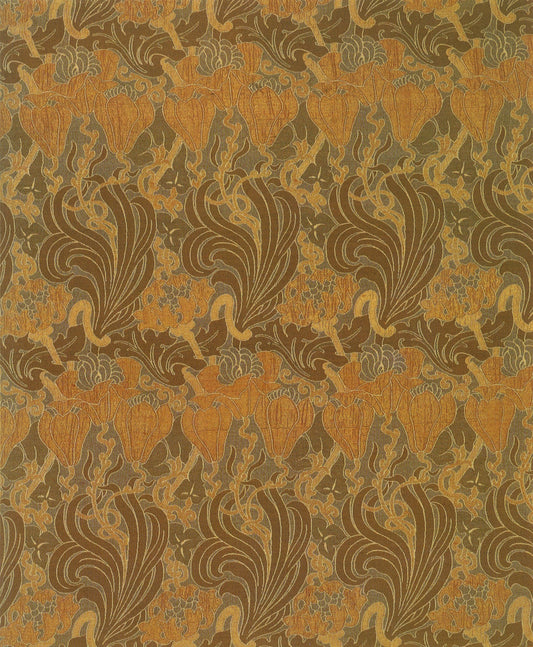
Morton, Alexander (1844-1923) - Reversible Woven Cotton c.1902
Vendor:Public Domain Image LibraryRegular price £0.80Regular priceUnit price per

Latest Picture Trove Blog Posts
View all-

Public Domain Artwork and Trade Marks: What You Need to Know
Artwork in the public domain can generally be reproduced, adapted and used commercially without copyright permission. However, copyright and trade mark rights are separate, and using a public-domain image in certain circumstances could still infringe an existing trade mark.
-

William Morris’s Strawberry Thief: The Story Behind a Classic Arts and Crafts Pattern
Few William Morris designs are as instantly recognisable as Strawberry Thief. With its richly patterned foliage, small red strawberries and watchful birds hidden among curling leaves, it has become one of the most loved designs of the Arts and Crafts movement.
-

Glasgow and the Mackintosh Style
We recently took ourselves off to Scotland, and on our travels, we popped into the Mackintosh Tea Rooms in Glasgow for a bit of a nose around and a spot of lunch.
Glasgow and the Mackintosh Style
We recently took ourselves off to Scotland, and on our travels, we popped into the Mackintosh Tea Rooms in Glasgow for a bit of a nose around and a spot of lunch.


