

Owen Jones (1809–1874) was a pioneering English architect, designer, and theorist whose influence on Victorian design remains profound.
Born in London, Jones initially trained as an architect under Lewis Vulliamy but soon developed interests beyond architecture, including the decorative arts, colour theory, and design education.
His career was marked by a distinctive approach that sought to reform and modernise British design by embracing historical and international sources, coupled with innovative thinking about ornamentation and colour.
A defining moment in Jones’s career came in 1834, when he embarked on an extended journey to Egypt and the Middle East, culminating in a detailed study of the Alhambra in Granada, Spain. The intricate Islamic decoration and the sophisticated use of geometry and colour he observed there left a lasting impression on him. His subsequent publication, "Plans, Elevations, Sections and Details of the Alhambra" (1842–45), not only established his reputation as a leading figure in design but also introduced British audiences to the extraordinary beauty and logic of Islamic art.
Jones’s magnum opus, however, was "The Grammar of Ornament," published in 1856. This lavishly illustrated folio became an essential reference for designers and students alike. The book presented a comprehensive visual catalogue of ornament from a wide range of cultures, ancient Egyptian, Greek, Roman, Islamic, Indian, Chinese, and more, accompanied by thirty-seven propositions that articulated his principles of good design. Jones advocated for the use of flat, pure colours and geometric forms, and he condemned the excessive and unprincipled eclecticism that typified much Victorian design. He believed that every age and culture had its own valid ornamental vocabulary, but that contemporary designers should learn from, rather than merely copy, the past.
Jones's theories found practical application in his work as the Superintendent of Works for the Crystal Palace at the Great Exhibition of 1851. He was responsible for the bold polychromatic decoration of the structure, which, though initially controversial, was later recognised as a pivotal moment in the acceptance of colour in British architecture.
Beyond his design and theoretical achievements, Jones was committed to education, teaching at institutions such as the Government School of Design. His legacy endures not only through his own works but also through the generations of designers he influenced. "The Grammar of Ornament" remains a landmark in design history, embodying Jones’s conviction that a scientific approach to ornament could elevate the arts and foster a truly modern aesthetic.
Images to download
-

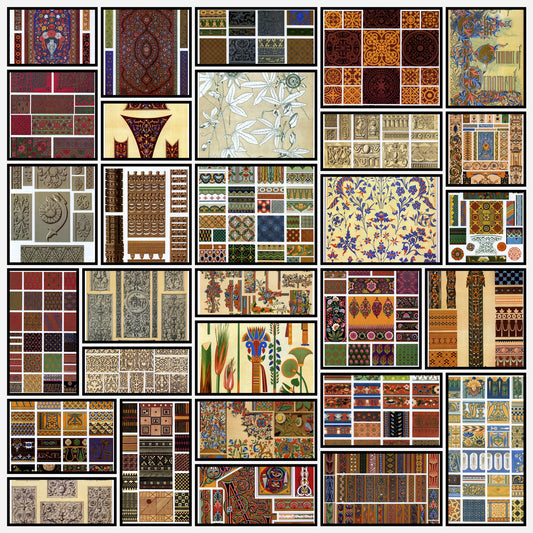
Owen Jones - The Grammar of Ornament - 101 High resolution Images
Vendor:Digital Download - 101 imagesRegular price £6.00Regular priceUnit price per

Latest Picture Trove Blog Posts
View all-

William Morris’s Strawberry Thief: The Story Behind a Classic Arts and Crafts Pattern
Few William Morris designs are as instantly recognisable as Strawberry Thief. With its richly patterned foliage, small red strawberries and watchful birds hidden among curling leaves, it has become one of the most loved designs of the Arts and Crafts movement.
William Morris’s Strawberry Thief: The Story Behind a Classic Arts and Crafts Pattern
Few William Morris designs are as instantly recognisable as Strawberry Thief. With its richly patterned foliage, small red strawberries and watchful birds hidden among curling leaves, it has become one of the most loved designs of the Arts and Crafts movement.
-

Glasgow and the Mackintosh Style
We recently took ourselves off to Scotland, and on our travels, we popped into the Mackintosh Tea Rooms in Glasgow for a bit of a nose around and a spot of lunch.
Glasgow and the Mackintosh Style
We recently took ourselves off to Scotland, and on our travels, we popped into the Mackintosh Tea Rooms in Glasgow for a bit of a nose around and a spot of lunch.
-

A Trip to Edinburgh & Glasgow, and Scottish Art
We have just returned from a well-deserved few days' break in Scotland, visiting both Edinburgh and Glasgow, taking in Scottish art and tea rooms!
A Trip to Edinburgh & Glasgow, and Scottish Art
We have just returned from a well-deserved few days' break in Scotland, visiting both Edinburgh and Glasgow, taking in Scottish art and tea rooms!


