

Joachim Wtewael (1566–1638) was a Dutch painter, draughtsman and businessman, and one of the principal representatives of Mannerism in Utrecht. His compositions are distinguished by intricate arrangements of figures, vivid colours and a taste for unusual poses and elaborate detail.
Born in Utrecht, he was the son of the glass painter Anthonis Wtewael. He trained with the painter Joos de Beer and later travelled through France and Italy, encountering the fashionable Mannerist styles of the late sixteenth century. After returning to Utrecht, he established himself as a painter of religious, mythological and allegorical subjects. Some were large, ambitious compositions, while others were finely detailed works painted on small copper panels.
Wtewael developed his art in the same flourishing Utrecht milieu as Abraham Bloemaert. Unlike painters who increasingly favoured naturalistic representation, he retained the highly stylised forms and brilliant colour combinations of late Mannerism.
In 1595 he married Christina van Halen. His Self-Portrait (1601), now at the Centraal Museum in Utrecht, shows him with palette and brushes. It was painted as a companion to a portrait of his wife and carries the Latin motto Non gloria, sed memoria, meaning ‘Not for glory, but for remembrance’.
Painting was not Wtewael's only occupation. He prospered as a flax merchant and was active in Utrecht's civic affairs, serving on the town council. In 1611 he helped found the city's Guild of Saint Luke. His wealth gave him an unusual degree of independence as an artist, allowing him to pursue elaborate subjects with considerable freedom.
Wtewael died in Utrecht in 1638. His paintings offer a distinctive example of the imaginative and decorative possibilities of Dutch Mannerism.
Images to download
-

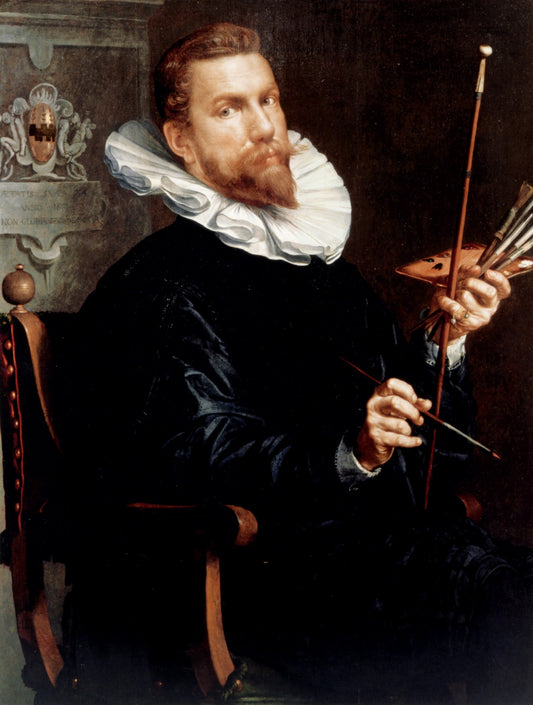
Wtewael, Joachim (1566-1638) - Self-portrait 1601
Vendor:Digital Download - 1 imageRegular price £0.80Regular priceUnit price per

Latest Picture Trove Blog Posts
View all-

Public Domain Artwork and Trade Marks: What You Need to Know
Artwork in the public domain can generally be reproduced, adapted and used commercially without copyright permission. However, copyright and trade mark rights are separate, and using a public-domain image in certain circumstances could still infringe an existing trade mark.
-

William Morris’s Strawberry Thief: The Story Behind a Classic Arts and Crafts Pattern
Few William Morris designs are as instantly recognisable as Strawberry Thief. With its richly patterned foliage, small red strawberries and watchful birds hidden among curling leaves, it has become one of the most loved designs of the Arts and Crafts movement.
-

Glasgow and the Mackintosh Style
We recently took ourselves off to Scotland, and on our travels, we popped into the Mackintosh Tea Rooms in Glasgow for a bit of a nose around and a spot of lunch.
Glasgow and the Mackintosh Style
We recently took ourselves off to Scotland, and on our travels, we popped into the Mackintosh Tea Rooms in Glasgow for a bit of a nose around and a spot of lunch.


