

William Arnold Woodhouse (1857–1939) was an English painter specialising in sporting subjects, particularly dogs, horses, birds and other animals. He was born on 1 October 1857 in Poulton-le-Sands, now part of Morecambe, Lancashire, and spent most of his life in the surrounding area.
He developed an early interest in wildlife and trained at the Lancaster and Nottingham schools of art. Woodhouse became known for realistic animal painting, building on a British tradition associated with Sir Edwin Landseer. His pictures often combine careful observation of anatomy and coats with the familiar settings of country life.
Dogs were among his favourite subjects, especially sporting breeds. In English and Gordon Setters with Game, he brings together two types of setter with game birds, a subject reflecting the longstanding association of these dogs with field sports. Similar pictures show retrievers, spaniels, horses and other working animals.
Woodhouse married in 1892 and lived at Kenilcote, a house on Chatsworth Road in Morecambe which he designed himself. In 1902 he moved with his family to Auburn Court, whose rural setting provided further subjects for his paintings. He travelled relatively little, preferring to work from the wildlife and landscapes familiar to him.
He painted in both oils and watercolour. Examples of his work are held by Lancaster City Museum and Lancaster Maritime Museum, while numerous sporting and animal pictures have passed through private collections.
Woodhouse died in 1939 and was buried at St Peter's Church in Heysham. His paintings preserve an affectionate, detailed record of animals and rural life in late Victorian and Edwardian England.
Images to download
-

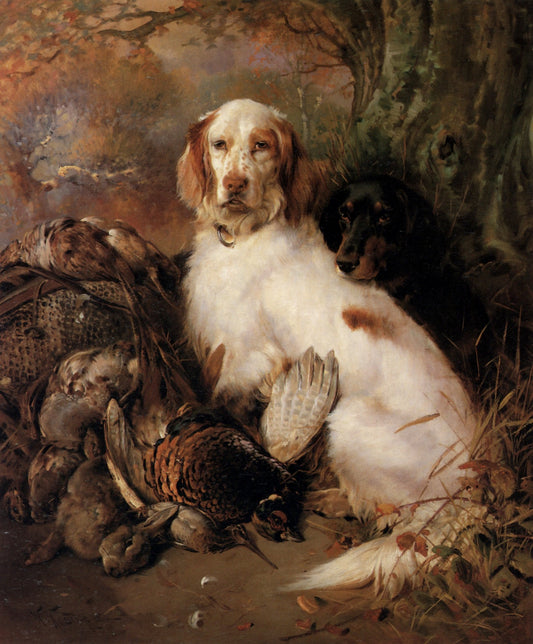
Woodhouse, William Arnold (1857-1939) - English & Gordon Setters with Game
Vendor:Digital Download - 1 imageRegular price £0.80Regular priceUnit price per

Latest Picture Trove Blog Posts
View all-

Public Domain Artwork and Trade Marks: What You Need to Know
Artwork in the public domain can generally be reproduced, adapted and used commercially without copyright permission. However, copyright and trade mark rights are separate, and using a public-domain image in certain circumstances could still infringe an existing trade mark.
-

William Morris’s Strawberry Thief: The Story Behind a Classic Arts and Crafts Pattern
Few William Morris designs are as instantly recognisable as Strawberry Thief. With its richly patterned foliage, small red strawberries and watchful birds hidden among curling leaves, it has become one of the most loved designs of the Arts and Crafts movement.
-

Glasgow and the Mackintosh Style
We recently took ourselves off to Scotland, and on our travels, we popped into the Mackintosh Tea Rooms in Glasgow for a bit of a nose around and a spot of lunch.
Glasgow and the Mackintosh Style
We recently took ourselves off to Scotland, and on our travels, we popped into the Mackintosh Tea Rooms in Glasgow for a bit of a nose around and a spot of lunch.


