

Charles Wild (1781–1835) was an English watercolour painter and architectural draughtsman born in London. He was apprenticed to Thomas Malton the Younger, a specialist in perspective who also taught J.M.W. Turner. Wild developed a particular interest in the accurate depiction of buildings, combining precise drawing with delicate colour.
He first exhibited at the Royal Academy in 1803, showing views of Christ Church, Oxford. He subsequently became a regular exhibitor with the Society of Painters in Water Colours, where he served as treasurer and later secretary. His subjects included cathedrals, historic buildings and the interiors of royal residences.
Wild is particularly associated with William Henry Pyne’s three-volume The History of the Royal Residences (1816–1819), for which he produced more than half of the 100 architectural views. Other contributors included William Westall. Wild’s images preserve detailed records of rooms, furnishings and decorative schemes in buildings such as Windsor Castle, Kensington Palace and Carlton House.
His The Circular Dining Room at Carlton House (1819) depicts one of the Prince Regent’s elaborate London interiors, with marble columns, chandeliers and a painted ceiling. The original watercolour belongs to the Cooper Hewitt, Smithsonian Design Museum.
Wild also published architectural views and prepared drawings of churches and cathedrals. His eyesight deteriorated towards the end of his career, and he eventually became blind. He died in London in 1835. His son James William Wild became an architect.
Images to download
-

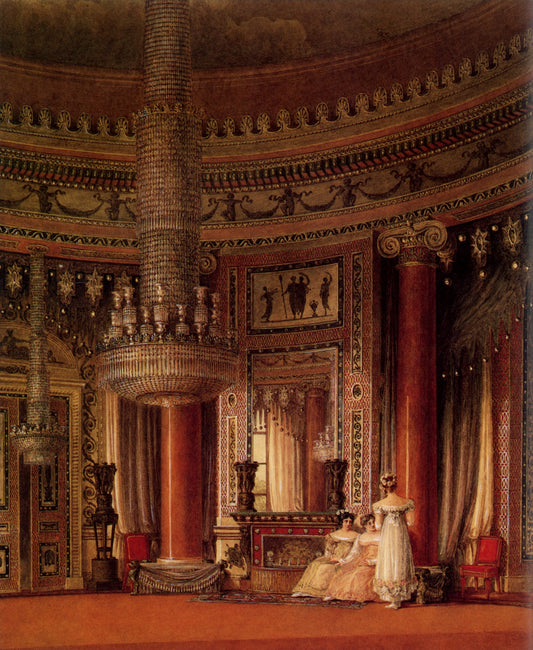
Wild, Charles (1781-1835) - Circular Dining Room at Carlton House 1819
Vendor:Digital Download - 1 imageRegular price £0.80Regular priceUnit price per

Latest Picture Trove Blog Posts
View all-

Public Domain Artwork and Trade Marks: What You Need to Know
Artwork in the public domain can generally be reproduced, adapted and used commercially without copyright permission. However, copyright and trade mark rights are separate, and using a public-domain image in certain circumstances could still infringe an existing trade mark.
-

William Morris’s Strawberry Thief: The Story Behind a Classic Arts and Crafts Pattern
Few William Morris designs are as instantly recognisable as Strawberry Thief. With its richly patterned foliage, small red strawberries and watchful birds hidden among curling leaves, it has become one of the most loved designs of the Arts and Crafts movement.
-

Glasgow and the Mackintosh Style
We recently took ourselves off to Scotland, and on our travels, we popped into the Mackintosh Tea Rooms in Glasgow for a bit of a nose around and a spot of lunch.
Glasgow and the Mackintosh Style
We recently took ourselves off to Scotland, and on our travels, we popped into the Mackintosh Tea Rooms in Glasgow for a bit of a nose around and a spot of lunch.


