

Charles Whymper (1853–1941) was an English painter, watercolourist and illustrator who specialised in birds, wildlife, landscapes and sporting subjects. His detailed studies of animals appeared in books and magazines, while his paintings often depicted birds in their natural surroundings.
Born in London on 31 August 1853, Whymper grew up in a family closely involved with art and engraving. His father, Josiah Wood Whymper (1813–1903), was a landscape painter and wood engraver, while his elder brother Edward Whymper (1840–1911) became known both for his engravings and for mountaineering. Charles studied at the Royal Academy Schools and developed his skills as a painter and illustrator. He also studied under the animal painter Joseph Wolf, whose careful observation of wildlife provided an important example.
Whymper worked extensively for publishers, producing illustrations of birds, mammals and subjects connected with travel and outdoor pursuits. His drawings appeared in periodicals including The Illustrated London News, Good Words and The English Illustrated Magazine. He also illustrated books on natural history and field sports, bringing a draughtsman’s precision to feathers, fur and the movement of animals.
His bird illustrations were especially valued for their accurate depiction of species. He supplied more than forty colour illustrations for Charles Dixon’s Game Birds and Wildfowl of the British Islands (1900), combining descriptive detail with a sense of setting. He also worked on subjects connected with the birdlife of Egypt and other regions, reflecting the growing public interest in natural history and travel during the late Victorian and Edwardian periods.
Alongside his commercial illustration, Whymper exhibited paintings and watercolours at the Royal Academy, the Royal Society of British Artists and other London venues. In 1909 he was elected to the Royal Institute of Painters in Water Colours. His subjects ranged from grouse and waterfowl to fishing scenes, landscapes and other forms of country life.
Whymper died on 25 April 1941 in Houghton, Cambridgeshire. His work belongs to the tradition of British natural history illustration, combining close observation with the pictorial qualities of watercolour painting. Readers interested in related animal painting can also explore the work of Edwin Landseer and Joseph Wolf.
Images to download
-

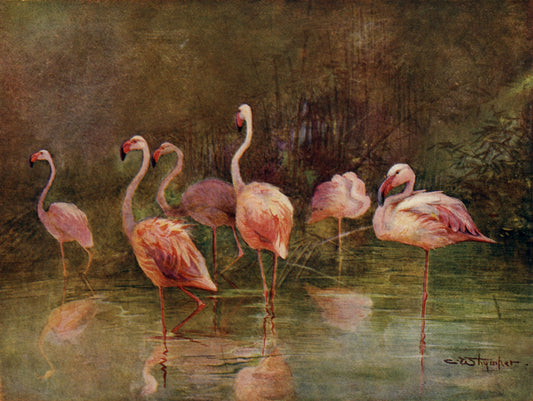
Whymper, Charles (1853-1941) - Flamingos at Home 1940s
Vendor:Digital Download - 1 imageRegular price £0.80Regular priceUnit price per -

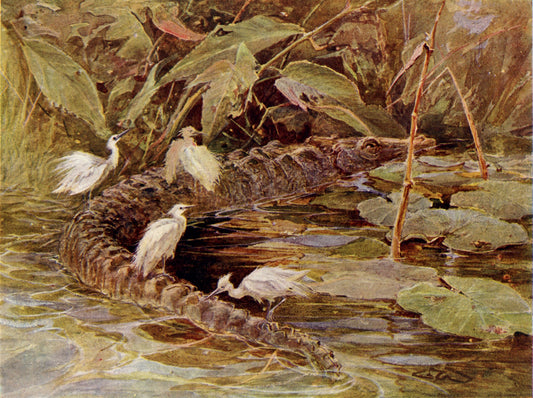
Whymper, Charles (1853-1941) - Crocodile and Attendant Egrets 1940s
Vendor:Digital Download - 1 imageRegular price £0.80Regular priceUnit price per -

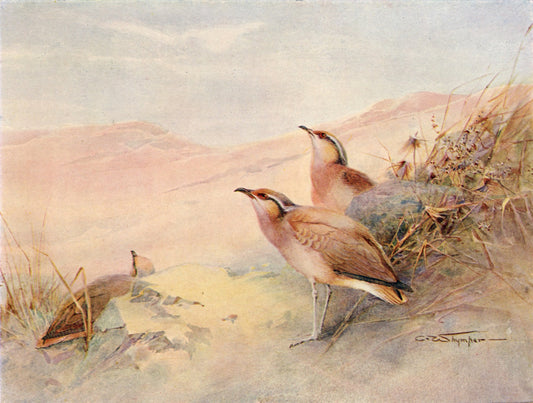
Whymper, Charles (1853-1941) - Birds of the Desert 1940s
Vendor:Digital Download - 1 imageRegular price £0.80Regular priceUnit price per


Latest Picture Trove Blog Posts
View all-

Public Domain Artwork and Trade Marks: What You Need to Know
Artwork in the public domain can generally be reproduced, adapted and used commercially without copyright permission. However, copyright and trade mark rights are separate, and using a public-domain image in certain circumstances could still infringe an existing trade mark.
-

William Morris’s Strawberry Thief: The Story Behind a Classic Arts and Crafts Pattern
Few William Morris designs are as instantly recognisable as Strawberry Thief. With its richly patterned foliage, small red strawberries and watchful birds hidden among curling leaves, it has become one of the most loved designs of the Arts and Crafts movement.
-

Glasgow and the Mackintosh Style
We recently took ourselves off to Scotland, and on our travels, we popped into the Mackintosh Tea Rooms in Glasgow for a bit of a nose around and a spot of lunch.
Glasgow and the Mackintosh Style
We recently took ourselves off to Scotland, and on our travels, we popped into the Mackintosh Tea Rooms in Glasgow for a bit of a nose around and a spot of lunch.


