

Sergei Yurievich Sudeikin (1882–1946), also known as Serge Soudeikine, was a Russian painter, illustrator and theatrical designer. Born in Saint Petersburg, he studied at the Moscow School of Painting, Sculpture and Architecture, where his teachers included Konstantin Korovin and Valentin Serov. His early paintings were influenced by Symbolism, and he became associated with the Blue Rose group, whose artists favoured dreamlike subjects, decorative colour and theatrical settings.
Sudeikin also exhibited with the World of Art circle and developed a distinctive visual language inspired by Russian popular entertainment, fairgrounds, puppet theatre and eighteenth-century aristocratic life. His work ranged from paintings and book illustrations to elaborate designs for opera and ballet. He worked with Sergei Diaghilev's Ballets Russes, including scenery for La Tragédie de Salomé in 1913.
Following the Russian Revolution, Sudeikin left Russia and worked with theatrical companies in Tbilisi, Paris and elsewhere. He travelled to the United States in the early 1920s and settled there, continuing to design sets and costumes for the stage. His The Chief Thing (1926) is a poster for a New York production of Nikolai Evreinov's play at the Guild Theatre, demonstrating the colourful graphic approach he brought to publicity as well as scenery.
He also designed productions for the Metropolitan Opera and continued to paint imaginative scenes and still lifes. Sudeikin died in New York state in 1946. His work reflects the movement of Russian modernist artists into European and American theatrical life during the first half of the twentieth century.
Images to download
-

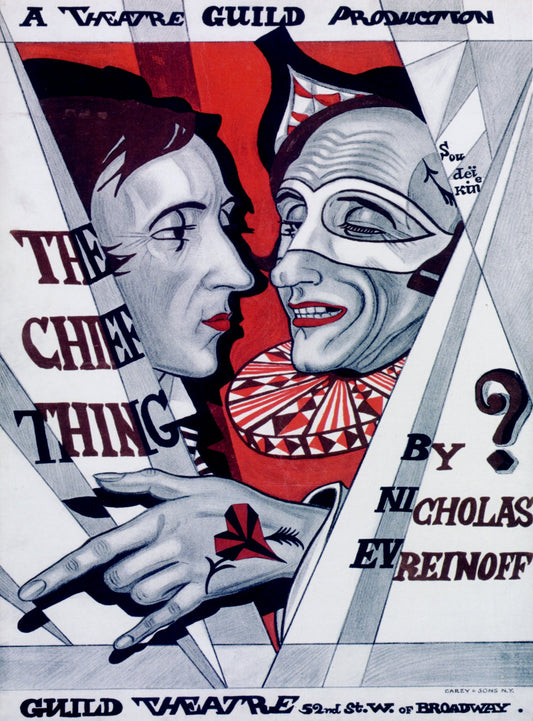
Sudeikin, Sergei Yurievich (1882-1946) - The Chief Thing 1926
Vendor:Digital Download - 1 imageRegular price £0.80Regular priceUnit price per

Latest Picture Trove Blog Posts
View all-

Public Domain Artwork and Trade Marks: What You Need to Know
Artwork in the public domain can generally be reproduced, adapted and used commercially without copyright permission. However, copyright and trade mark rights are separate, and using a public-domain image in certain circumstances could still infringe an existing trade mark.
-

William Morris’s Strawberry Thief: The Story Behind a Classic Arts and Crafts Pattern
Few William Morris designs are as instantly recognisable as Strawberry Thief. With its richly patterned foliage, small red strawberries and watchful birds hidden among curling leaves, it has become one of the most loved designs of the Arts and Crafts movement.
-

Glasgow and the Mackintosh Style
We recently took ourselves off to Scotland, and on our travels, we popped into the Mackintosh Tea Rooms in Glasgow for a bit of a nose around and a spot of lunch.
Glasgow and the Mackintosh Style
We recently took ourselves off to Scotland, and on our travels, we popped into the Mackintosh Tea Rooms in Glasgow for a bit of a nose around and a spot of lunch.


