

Joseph Henry Sharp (1859–1953) stands as a significant yet sometimes underappreciated figure in the history of American art, particularly for his evocative depictions of Native American subjects and the landscapes of the American West. Born in Bridgeport, Ohio, Sharp’s early life was marked by adversity; an accident at the age of 12 left him partially deaf. Nevertheless, his passion for art was unwavering. He studied at the McMicken School of Design in Cincinnati and later honed his skills at the prestigious Académie Julian and École des Beaux-Arts in Paris, where he was influenced by European academic traditions and the burgeoning Impressionist movement.
Sharp’s career truly flourished after he travelled to the American West in the 1890s. Fascinated by the culture and dignity of Native American peoples, particularly the Crow and Blackfeet nations, he dedicated much of his artistic life to recording their lives and traditions. He made his first trip to Taos, New Mexico, in 1893 and was so captivated by the region’s unique light and vibrant colours that he returned regularly. Sharp became a founding member of the Taos Society of Artists in 1915, joining the ranks of other celebrated painters such as Ernest L. Blumenschein and E. Irving Couse. The Society aimed to promote the art of the American Southwest to a broader audience and played a crucial role in establishing Taos as an artistic hub.
Over his prolific career, Sharp created an estimated 10,500 works, including portraits, genre scenes, and landscapes. His portraits of Native American elders, warriors, and children are particularly revered for their sensitivity, detail, and ethnographic accuracy. Unlike many contemporaries who often romanticised or stereotyped their subjects, Sharp sought to represent the individuality and humanity of each sitter. His meticulous approach, combined with a keen eye for colour and composition, resulted in works that are both artistically accomplished and historically valuable.
Sharp’s legacy extends beyond his paintings. Through his work, he helped preserve a visual record of Indigenous cultures at a time when many traditions were threatened by rapid social change. Today, his art is held in major collections, including the Smithsonian American Art Museum and the Gilcrease Museum, and continues to inspire appreciation for the cultural richness of the American West. Sharp’s enduring contribution lies not only in his technical mastery but also in his empathetic engagement with the peoples and places he so lovingly depicted.
Images to download
-

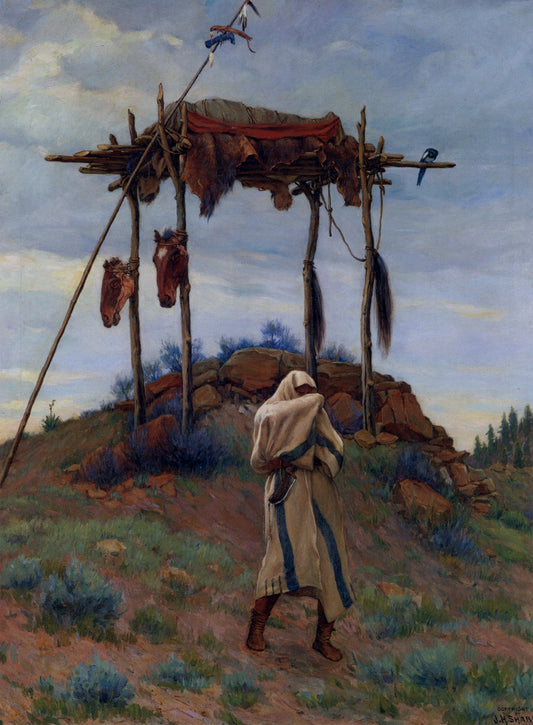
Sharp, Joseph Henry (1859-1953) - The Voice of the Great Spirit 1906
Vendor:Digital Download - 1 imageRegular price £0.80Regular priceUnit price per -

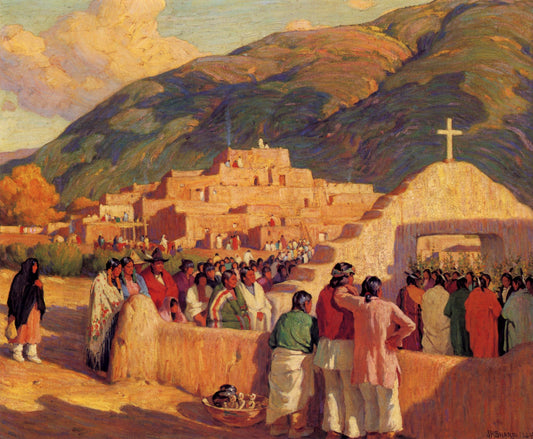
Sharp, Joseph Henry (1859-1953) - Sunset Dance, Ceremony into the Evening Sun 1924
Vendor:Digital Download - 1 imageRegular price £0.80Regular priceUnit price per


Latest Picture Trove Blog Posts
View all-

William Morris’s Strawberry Thief: The Story Behind a Classic Arts and Crafts Pattern
Few William Morris designs are as instantly recognisable as Strawberry Thief. With its richly patterned foliage, small red strawberries and watchful birds hidden among curling leaves, it has become one of the most loved designs of the Arts and Crafts movement.
William Morris’s Strawberry Thief: The Story Behind a Classic Arts and Crafts Pattern
Few William Morris designs are as instantly recognisable as Strawberry Thief. With its richly patterned foliage, small red strawberries and watchful birds hidden among curling leaves, it has become one of the most loved designs of the Arts and Crafts movement.
-

Glasgow and the Mackintosh Style
We recently took ourselves off to Scotland, and on our travels, we popped into the Mackintosh Tea Rooms in Glasgow for a bit of a nose around and a spot of lunch.
Glasgow and the Mackintosh Style
We recently took ourselves off to Scotland, and on our travels, we popped into the Mackintosh Tea Rooms in Glasgow for a bit of a nose around and a spot of lunch.
-

A Trip to Edinburgh & Glasgow, and Scottish Art
We have just returned from a well-deserved few days' break in Scotland, visiting both Edinburgh and Glasgow, taking in Scottish art and tea rooms!
A Trip to Edinburgh & Glasgow, and Scottish Art
We have just returned from a well-deserved few days' break in Scotland, visiting both Edinburgh and Glasgow, taking in Scottish art and tea rooms!


