

Sassetta, the name by which Stefano di Giovanni (c.1392–1450) is known, was an Italian painter of the early Renaissance associated with the Sienese School. His paintings combine delicate colour, graceful figures and intricate narrative detail with an increasing interest in natural observation. He worked mainly in Siena, producing altarpieces and devotional pictures. St Francis Renounces His Earthly Father was painted between 1437 and 1444 as part of a Franciscan altarpiece for the church of San Francesco in Borgo San Sepolcro. The scene shows the young saint rejecting his family's wealth in favour of religious poverty. Sassetta died in 1450. His work bridges late Gothic elegance and early Renaissance storytelling.
Sassetta worked within a Sienese tradition valuing graceful line, precious colour and devotional storytelling. His panels place small figures in carefully arranged architectural and landscape settings, allowing viewers to follow episodes from saints' lives. The Franciscan altarpiece was a major commission whose individual panels were later dispersed among collections. The episode of St Francis renouncing his father illustrates the saint's rejection of inherited wealth and his embrace of poverty. Sassetta makes the story understandable through gesture and the placement of figures. His paintings are especially important for understanding early Renaissance developments beyond Florence.
Images to download
-

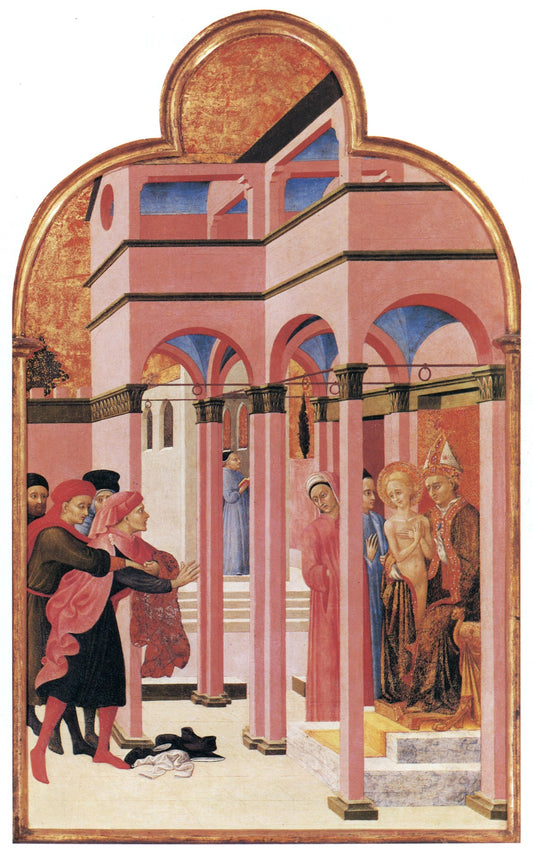
Sassetta (1392-1450) - St Francis Renounces his Earthly Father 1437-44
Vendor:Digital Download - 1 imageRegular price £0.80Regular priceUnit price per

Latest Picture Trove Blog Posts
View all-

Public Domain Artwork and Trade Marks: What You Need to Know
Artwork in the public domain can generally be reproduced, adapted and used commercially without copyright permission. However, copyright and trade mark rights are separate, and using a public-domain image in certain circumstances could still infringe an existing trade mark.
-

William Morris’s Strawberry Thief: The Story Behind a Classic Arts and Crafts Pattern
Few William Morris designs are as instantly recognisable as Strawberry Thief. With its richly patterned foliage, small red strawberries and watchful birds hidden among curling leaves, it has become one of the most loved designs of the Arts and Crafts movement.
-

Glasgow and the Mackintosh Style
We recently took ourselves off to Scotland, and on our travels, we popped into the Mackintosh Tea Rooms in Glasgow for a bit of a nose around and a spot of lunch.
Glasgow and the Mackintosh Style
We recently took ourselves off to Scotland, and on our travels, we popped into the Mackintosh Tea Rooms in Glasgow for a bit of a nose around and a spot of lunch.


