

Étienne Pierre Théodore Rousseau (1812-1867) was a French painter of the Barbizon School.
He was born in Paris, France, on 15th April 1812 to a bourgeois family. At first he received a basic level of training, but soon displayed an aptitude for painting. Théodore Rousseau shared the difficulties of the romantic painters of 1830 in securing for their pictures a place in the annual Paris exhibition. The influence of classically trained artists was against them, and not until 1848 was Rousseau presented adequately to the public.
He had exhibited six works in the Salons of 1831, 1833, 1834 and 1835, but in 1836 his great work Paysage du Jura [La descente des vaches] was rejected by the Salon jury. He sent a total of eight further works to the Salon between 1836 and 1841; and yet none of them were accepted. Thereafter, he ceased sending work to the Salon until 1849, when all three of his submissions were accepted. He was not without champions in the press, and with the title of "le grand refusé" he became known through the writings of his friend Théophile Thoré, the critic who afterwards resided in England and wrote using the name Burger.
During these years of artistic exile Rousseau produced some of his best pictures: The Chestnut Avenue, The Marsh in the Landes (now in the Louvre), Hoar-Frost (now in America); and in 1851, after the reorganisation of the Salon of 1848, he exhibited his masterpiece, The Edge of the Forest (also in the Louvre), a picture similar in treatment to, but slightly varied in subject from, the composition called A Glade in the Forest of Fontainebleau, in the Wallace Collection at Hertford House, London.
Until this period Rousseau had lived only occasionally at Barbizon, but in 1848 he took up his residence in the forest village, and spent most of his remaining days in the vicinity. He was now able to obtain fair sums for his pictures (but only about one-tenth of their value thirty years after his death), and the number of his admirers increased. He was still ignored by the authorities, even while his mentee Narcisse Virgilio Diaz was made Chevalier of the Legion of Honour in 1851. Rousseau was left undecorated, but was nominated and awarded the Cross soon afterwards. He would eventually become an Officer of the Legion of Honour.
At the Exposition Universelle of 1855, where all Rousseau's rejected pictures of the previous twenty years were gathered together, his works were acknowledged to form one of the best of the many groups there exhibited. But, after an unsuccessful sale of his works by auction in 1861, he contemplated leaving Paris for Amsterdam or London, or even New York.
Rousseau then suffered a series of misfortunes. His wife's mental health had worsened; his aged father became dependent on him for pecuniary assistance; his patrons were few. Moreover, while he was temporarily absent with his ill wife, a youth living in his home (a friend of his family) committed suicide in his Barbizon cottage. When he visited the Alps in 1863, making sketches of Mont Blanc, he became dangerously ill with inflammation of the lungs; and when he returned to Barbizon he suffered from insomnia and became gradually weakened.
Rousseau's other friend and neighbour, Jules Dupré, himself an eminent landscape painter of Barbizon, relates the difficulty Rousseau experienced in knowing when his picture was finished, and how he, Dupré, would sometimes take away from the studio some canvas on which Rousseau was labouring too long. Rousseau was a good friend to Diaz, teaching him how to paint trees, for until a certain point in his career Diaz considered he could only paint figures.
He was elected president of the fine-art jury for the 1867 Exposition; however, his disappointment at being denied the better awards may have affected his health, for in August he became paralysed. He recovered slightly, but was again attacked several times during the autumn. In November his condition worsened, and he died in the presence of his lifelong friend, Jean-François Millet, on 22 December 1867. Millet, the peasant painter, for whom Rousseau had the greatest regard, had been with him much during the last years of his life, and at his death Millet assumed charge of Rousseau's ill wife.
Images to download
-

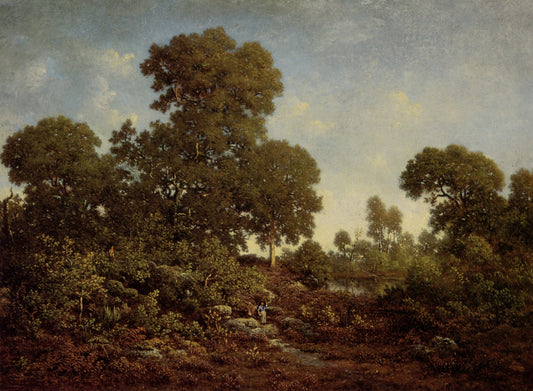
Rousseau, Theodore (1812-1867) - Springtime c.1860
Vendor:Digital Download - 1 imageRegular price £0.80Regular priceUnit price per

Latest Picture Trove Blog Posts
View all-

William Morris’s Strawberry Thief: The Story Behind a Classic Arts and Crafts Pattern
Few William Morris designs are as instantly recognisable as Strawberry Thief. With its richly patterned foliage, small red strawberries and watchful birds hidden among curling leaves, it has become one of the most loved designs of the Arts and Crafts movement.
-

Glasgow and the Mackintosh Style
We recently took ourselves off to Scotland, and on our travels, we popped into the Mackintosh Tea Rooms in Glasgow for a bit of a nose around and a spot of lunch.
Glasgow and the Mackintosh Style
We recently took ourselves off to Scotland, and on our travels, we popped into the Mackintosh Tea Rooms in Glasgow for a bit of a nose around and a spot of lunch.
-

A Trip to Edinburgh & Glasgow, and Scottish Art
We have just returned from a well-deserved few days' break in Scotland, visiting both Edinburgh and Glasgow, taking in Scottish art and tea rooms!
A Trip to Edinburgh & Glasgow, and Scottish Art
We have just returned from a well-deserved few days' break in Scotland, visiting both Edinburgh and Glasgow, taking in Scottish art and tea rooms!


