

William Blake Richmond (1842–1921) was a distinguished British painter, sculptor, and decorative artist, whose career spanned the late Victorian and Edwardian periods. Born in London, Richmond was the son of George Richmond, a renowned portrait painter and a member of the artistic circle that included members of the Pre-Raphaelite Brotherhood. The influence of his father, as well as the intellectual and artistic environment in which he was raised, shaped Richmond’s own career and sensibilities from an early age.
William Blake Richmond, named after the visionary poet and artist William Blake, received his earliest training at home and later attended the Royal Academy Schools, where he quickly distinguished himself. His early works, often portraits, reflected both technical skill and a sense of psychological depth, and he soon established a reputation in London’s artistic circles. However, Richmond’s interests extended well beyond portraiture. He travelled extensively in Italy, absorbing the colours, techniques, and compositional principles of the Italian Renaissance, which would remain a lifelong influence.
Richmond’s work is notable for its diversity. In addition to portraiture, he produced landscapes, allegorical scenes, and large-scale decorative commissions. His paintings often blend classical and symbolist themes, and his use of rich, luminous colour and intricate detail set his works apart from those of many of his contemporaries. Richmond was also deeply interested in the relationship between art and architecture, which led to his most celebrated commission: the decoration of St Paul’s Cathedral in London.
Appointed in 1891 as the artistic director for the mosaics in St Paul’s Cathedral, Richmond dedicated nearly two decades to the project. His vision transformed the interiors with elaborate Byzantine-inspired mosaics, bringing colour and splendour to the previously austere spaces. The mosaics, which depict a range of biblical and allegorical subjects, are now considered among the most significant decorative works in any British church.
Throughout his career, Richmond was an advocate for the integration of the arts. He believed that painting, sculpture, and architecture should work together to create harmonious environments. He was also active as a teacher and lecturer, and his influence extended to many younger artists of his day.
William Blake Richmond died in 1921, leaving behind a legacy marked by technical mastery, creative ambition, and a commitment to the ideal of the complete work of art. Today, he is remembered not only for his own artistic achievements, but also as a link between the generations of Victorian artists and the modern movements that followed.
Images to download
-

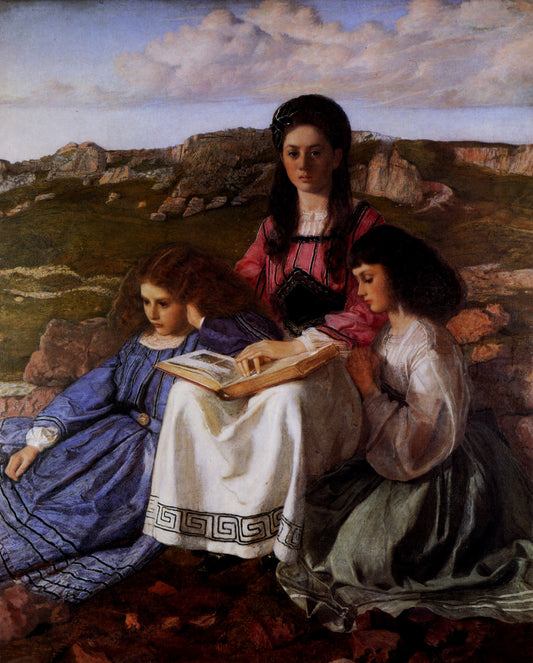
Richmond, William Blake (1842-1921) - Three Daughters of Dean Liddell 1860s
Vendor:Digital Download - 1 imageRegular price £0.80Regular priceUnit price per

Latest Picture Trove Blog Posts
View all-

William Morris’s Strawberry Thief: The Story Behind a Classic Arts and Crafts Pattern
Few William Morris designs are as instantly recognisable as Strawberry Thief. With its richly patterned foliage, small red strawberries and watchful birds hidden among curling leaves, it has become one of the most loved designs of the Arts and Crafts movement.
William Morris’s Strawberry Thief: The Story Behind a Classic Arts and Crafts Pattern
Few William Morris designs are as instantly recognisable as Strawberry Thief. With its richly patterned foliage, small red strawberries and watchful birds hidden among curling leaves, it has become one of the most loved designs of the Arts and Crafts movement.
-

Glasgow and the Mackintosh Style
We recently took ourselves off to Scotland, and on our travels, we popped into the Mackintosh Tea Rooms in Glasgow for a bit of a nose around and a spot of lunch.
Glasgow and the Mackintosh Style
We recently took ourselves off to Scotland, and on our travels, we popped into the Mackintosh Tea Rooms in Glasgow for a bit of a nose around and a spot of lunch.
-

A Trip to Edinburgh & Glasgow, and Scottish Art
We have just returned from a well-deserved few days' break in Scotland, visiting both Edinburgh and Glasgow, taking in Scottish art and tea rooms!
A Trip to Edinburgh & Glasgow, and Scottish Art
We have just returned from a well-deserved few days' break in Scotland, visiting both Edinburgh and Glasgow, taking in Scottish art and tea rooms!


