

Antoine Plamondon (1804–1895) was a Canadian painter best known for portraits and religious subjects. Born near Québec City, he trained with the painter Joseph Légaré, helping to restore European paintings, before travelling to Paris in 1826 to study with Jean-Baptiste Paulin Guérin. His academic training influenced his careful drawing and controlled compositions.
After returning to Lower Canada in 1830, Plamondon became an important figure in Québec’s artistic life. He taught drawing at the Séminaire de Québec and received commissions from families, churches and religious communities. Although he also made landscapes and history paintings, portraiture brought him particular distinction.
His Sœur Saint-Alphonse (1841) portrays an Augustinian nun seated in a black veil and white habit, holding a small red book. The sitter’s clear features, silver cross and restrained setting give the painting both dignity and a quiet devotional character. It was one of three portraits of nuns associated with the Hôpital général de Québec, commissioned by their families. The painting belongs to the National Gallery of Canada.
Plamondon’s former pupil Théophile Hamel later developed a successful portrait practice and became a competitor. Together with their mentor Joseph Légaré, the two painters shaped the development of nineteenth-century French-Canadian art. Their work belongs to a different branch of Canadian painting from the wilderness subjects of Thomas Cole across the border in the United States.
Plamondon was a founding vice-president of the Royal Canadian Academy of Arts in 1880. He died at Neuville, Québec, in 1895.
Images to download
-

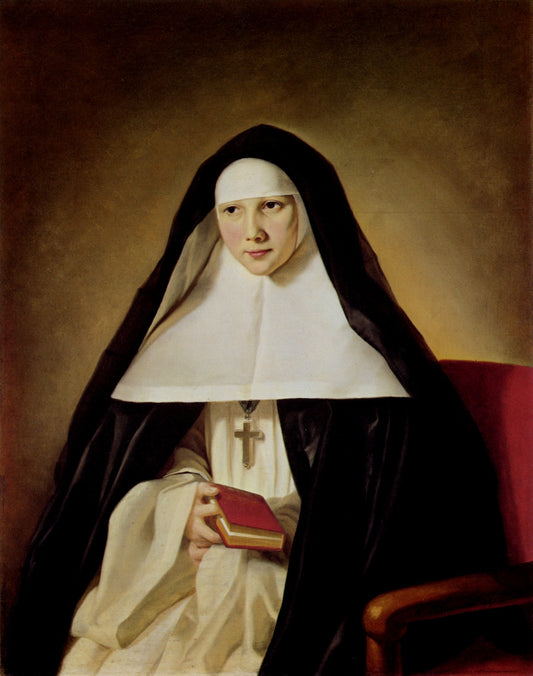
Plamondon, Antoine (1804-1895) - Soeur Saint-Alphonse 1841
Vendor:Public Domain Image LibraryRegular price £0.80Regular priceUnit price per

Latest Picture Trove Blog Posts
View all-

Public Domain Artwork and Trade Marks: What You Need to Know
Artwork in the public domain can generally be reproduced, adapted and used commercially without copyright permission. However, copyright and trade mark rights are separate, and using a public-domain image in certain circumstances could still infringe an existing trade mark.
-

William Morris’s Strawberry Thief: The Story Behind a Classic Arts and Crafts Pattern
Few William Morris designs are as instantly recognisable as Strawberry Thief. With its richly patterned foliage, small red strawberries and watchful birds hidden among curling leaves, it has become one of the most loved designs of the Arts and Crafts movement.
-

Glasgow and the Mackintosh Style
We recently took ourselves off to Scotland, and on our travels, we popped into the Mackintosh Tea Rooms in Glasgow for a bit of a nose around and a spot of lunch.
Glasgow and the Mackintosh Style
We recently took ourselves off to Scotland, and on our travels, we popped into the Mackintosh Tea Rooms in Glasgow for a bit of a nose around and a spot of lunch.


