

Arthur Parton (1842–1914) was an American landscape painter whose work bridged the detailed naturalism of the Hudson River School and the softer, atmospheric approaches associated with the Barbizon School and Tonalism. His favourite subjects included wooded valleys, rivers, quiet country roads and the mountains of New York State.
Born in Hudson, New York, in 1842, Parton grew up surrounded by the scenery that inspired several leading American landscape painters. Sanford Robinson Gifford, Frederic Edwin Church and other artists worked in the Hudson River region during his youth. By 1860 Parton was studying in Philadelphia under William Trost Richards, whose careful observation of nature strongly influenced his early painting.
His first recorded exhibition at the Pennsylvania Academy of the Fine Arts took place in 1861. Early pictures show a painstaking attention to trees, rocks and plants, reflecting the belief that landscape painting should be grounded in direct study of the natural world. Parton nevertheless sought to create balanced, attractive compositions rather than simple topographical records.
After travelling in Europe in 1869, he began experimenting with a looser style influenced by French Barbizon painters. His landscapes gradually became softer in handling and more concerned with tonal harmony, subdued light and atmosphere. This development gave his mature pictures a character distinct from the sharply detailed work of some earlier Hudson River School artists.
Parton spent much of his career in New York City, maintaining a studio in the Tenth Street Studio Building from the 1870s. He frequently travelled to the Catskill and Adirondack mountains to sketch. His view of the Shenandoah River gained wider recognition through its reproduction in William Cullen Bryant’s illustrated publication Picturesque America.
During a long career, Parton received recognition at major exhibitions, including awards associated with the Pennsylvania Academy of the Fine Arts, the National Academy of Design and the Louisiana Purchase Exposition in St Louis in 1904. His work shows how American landscape painting changed as artists absorbed new European influences without abandoning familiar local subjects.
Parton died in Yonkers, New York, in 1914. His paintings remain valuable examples of the transition from Hudson River School naturalism towards the more atmospheric landscape styles of the late nineteenth century.
Images to download
-

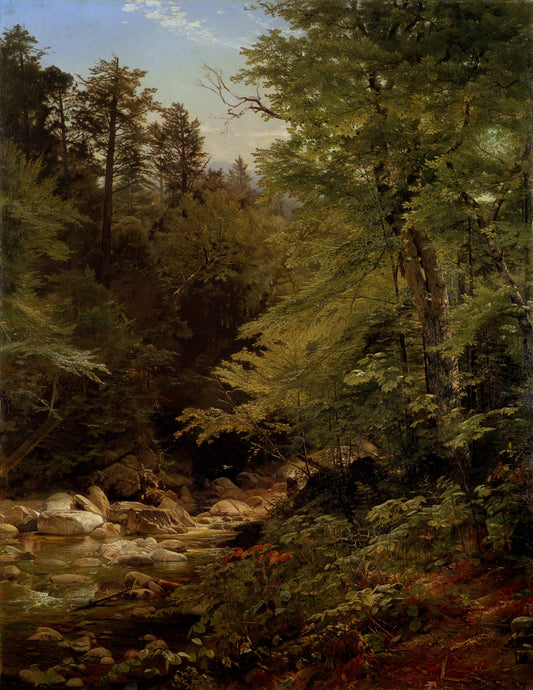
Parton, Arthur (1842-1819) - A Mountain Brook 1875
Vendor:Digital Download - 1 imageRegular price £0.80Regular priceUnit price per

Latest Picture Trove Blog Posts
View all-

William Morris’s Strawberry Thief: The Story Behind a Classic Arts and Crafts Pattern
Few William Morris designs are as instantly recognisable as Strawberry Thief. With its richly patterned foliage, small red strawberries and watchful birds hidden among curling leaves, it has become one of the most loved designs of the Arts and Crafts movement.
-

Glasgow and the Mackintosh Style
We recently took ourselves off to Scotland, and on our travels, we popped into the Mackintosh Tea Rooms in Glasgow for a bit of a nose around and a spot of lunch.
Glasgow and the Mackintosh Style
We recently took ourselves off to Scotland, and on our travels, we popped into the Mackintosh Tea Rooms in Glasgow for a bit of a nose around and a spot of lunch.
-

A Trip to Edinburgh & Glasgow, and Scottish Art
We have just returned from a well-deserved few days' break in Scotland, visiting both Edinburgh and Glasgow, taking in Scottish art and tea rooms!
A Trip to Edinburgh & Glasgow, and Scottish Art
We have just returned from a well-deserved few days' break in Scotland, visiting both Edinburgh and Glasgow, taking in Scottish art and tea rooms!


