

Samuel Finley Breese Morse (1791–1872) was an American painter and inventor, remembered both for his work in portraiture and for his part in developing the electric telegraph. Born in Charlestown, Massachusetts, he studied at Yale College before travelling to Britain in 1811 to pursue artistic training.
In London he studied under Washington Allston and attended the Royal Academy Schools. After returning to America, he established himself as a portrait painter and became a leading advocate for art education. He helped found the National Academy of Design in New York in 1825 and served as its first president.
Morse returned to Europe from 1829 to 1832, studying important works of art and sketching picturesque scenery. His landscape The Wetterhorn and the Reichenbach Falls, dated to about 1832, records the dramatic mountain and waterfall scenery of Switzerland.
During the 1830s his attention increasingly turned towards experiments in long-distance electrical communication. Together with collaborators, Morse developed a practical system of telegraphy, and his name became associated with Morse code. His painting career was subsequently overshadowed by his inventions, but works such as his portraits and landscapes reflect the interests of early American artists including John Vanderlyn. Morse died in New York in 1872.
Images to download
-

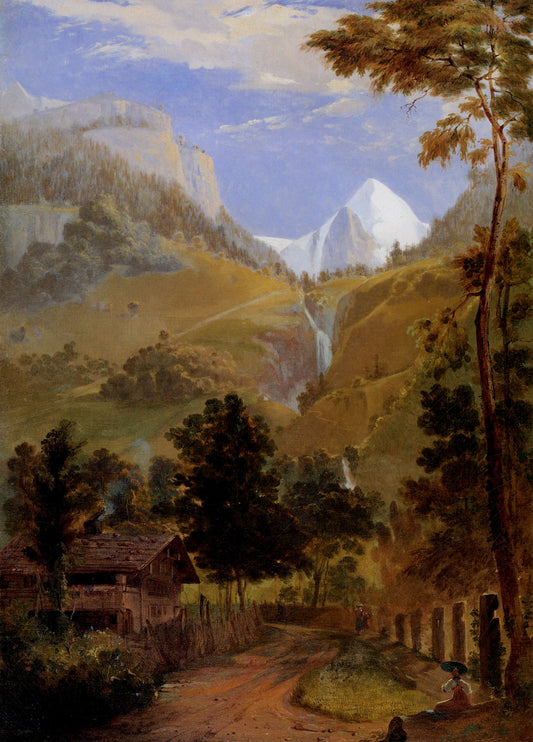
Morse, Samuel - The Wetterhorn and Reichenbach Falls c.1832
Vendor:Public Domain Image LibraryRegular price £0.80Regular priceUnit price per

Latest Picture Trove Blog Posts
View all-

Public Domain Artwork and Trade Marks: What You Need to Know
Artwork in the public domain can generally be reproduced, adapted and used commercially without copyright permission. However, copyright and trade mark rights are separate, and using a public-domain image in certain circumstances could still infringe an existing trade mark.
-

William Morris’s Strawberry Thief: The Story Behind a Classic Arts and Crafts Pattern
Few William Morris designs are as instantly recognisable as Strawberry Thief. With its richly patterned foliage, small red strawberries and watchful birds hidden among curling leaves, it has become one of the most loved designs of the Arts and Crafts movement.
-

Glasgow and the Mackintosh Style
We recently took ourselves off to Scotland, and on our travels, we popped into the Mackintosh Tea Rooms in Glasgow for a bit of a nose around and a spot of lunch.
Glasgow and the Mackintosh Style
We recently took ourselves off to Scotland, and on our travels, we popped into the Mackintosh Tea Rooms in Glasgow for a bit of a nose around and a spot of lunch.


