

William Marlow (1740–1813) was an English landscape and topographical painter born in Southwark, London. He studied with the marine and cityscape painter Samuel Scott, who encouraged his interest in buildings, river scenes and carefully observed views. Marlow worked in oils and watercolours and also produced etchings.
After painting English landscapes and London streets, Marlow travelled through France and Italy in 1765–66, reportedly on the advice of the Duchess of Northumberland. In Rome, Florence and other cities he made drawings that provided material for later paintings. His precise architectural views were influenced by the Venetian painter Canaletto, whose work was admired by British collectors and travellers on the Grand Tour.
His A Back View of St Peter’s at Rome (c.1783) offers an unusual perspective of the Vatican basilica, viewed from behind rather than across St Peter’s Square. A later painting, Capriccio: St Paul’s and a Venetian Canal (c.1795), imaginatively places Christopher Wren’s London cathedral on a waterway in Venice. This architectural fantasy is in Tate’s collection.
Marlow exhibited at the Society of Artists and the Royal Academy and became vice-president of the Society of Artists in 1778. He settled in Twickenham around 1785 and continued to work as a painter. He died there in 1813.
Images to download
-

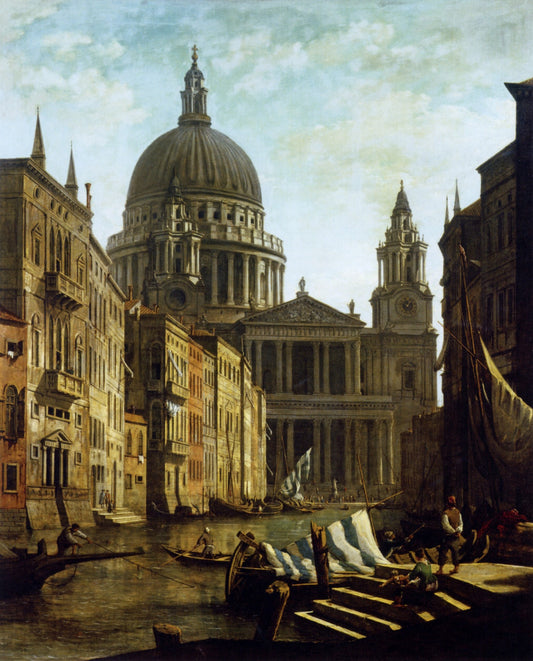
Marlow, William - Capriccio, St Paul’s and a Venetian Canal c.1795
Vendor:Digital Download - 1 imageRegular price £0.80Regular priceUnit price per -


Marlow, William (1740-1813) - A Back View of St Peter's at Rome c.1783
Vendor:Digital Download - 1 imageRegular price £0.80Regular priceUnit price per


Latest Picture Trove Blog Posts
View all-

Public Domain Artwork and Trade Marks: What You Need to Know
Artwork in the public domain can generally be reproduced, adapted and used commercially without copyright permission. However, copyright and trade mark rights are separate, and using a public-domain image in certain circumstances could still infringe an existing trade mark.
-

William Morris’s Strawberry Thief: The Story Behind a Classic Arts and Crafts Pattern
Few William Morris designs are as instantly recognisable as Strawberry Thief. With its richly patterned foliage, small red strawberries and watchful birds hidden among curling leaves, it has become one of the most loved designs of the Arts and Crafts movement.
-

Glasgow and the Mackintosh Style
We recently took ourselves off to Scotland, and on our travels, we popped into the Mackintosh Tea Rooms in Glasgow for a bit of a nose around and a spot of lunch.
Glasgow and the Mackintosh Style
We recently took ourselves off to Scotland, and on our travels, we popped into the Mackintosh Tea Rooms in Glasgow for a bit of a nose around and a spot of lunch.


