

George Luks (1867-1933) was a prominent American artist and a key figure in the Ashcan School, a movement that emerged in the early twentieth century centred on depicting the realities of urban life. Born in Williamsport, Pennsylvania, Luks was the son of a physician and displayed an interest in art from an early age. He briefly attended the Pennsylvania Academy of the Fine Arts before moving to Europe, where he studied in Düsseldorf, London, and Paris. This exposure to European art, particularly the works of the Old Masters and contemporary realists, had a significant impact on his style.
Returning to the United States in the 1890s, Luks began his career as an illustrator for newspapers, including Joseph Pulitzer’s New York World. His work as a newspaper artist sharpened his observational skills and deepened his fascination with the vibrancy and grit of city life. Luks soon became associated with a group of like-minded artists—Robert Henri, John Sloan, Everett Shinn, and William Glackens—who would later form the core of the Ashcan School. These artists sought to move away from the genteel subjects favoured by the American art establishment, focusing instead on the everyday experiences of ordinary people.
Luks is best known for his robust, energetic brushwork and his candid portrayals of working-class New Yorkers. Notable paintings such as “Hester Street” (1905) and “The Spielers” (1905) exemplify his interest in urban street scenes, immigration, and social diversity. His palette was often bold, and his approach to form was vigorous, lending his subjects a sense of immediacy and authenticity.
Throughout his career, Luks exhibited widely, including at the landmark 1908 exhibition at the Macbeth Gallery in New York, which helped to cement the Ashcan School’s reputation. He also taught at the Art Students League of New York, influencing a new generation of artists.
Despite his successes, Luks was known for his bohemian lifestyle and outspoken personality, which sometimes led to controversy.
Luks was married twice but had no children.
Luks was found dead in a doorway by a policeman in the early morning hours of 29 October 1933. Ira Glackens, the son of William Glackens, wrote about Luks's death that, contrary to the newspaper account stating that the painter had succumbed on his way to paint the dawn sky, he had actually been beaten to death in an altercation with a customer at a nearby bar.
Images to download
-

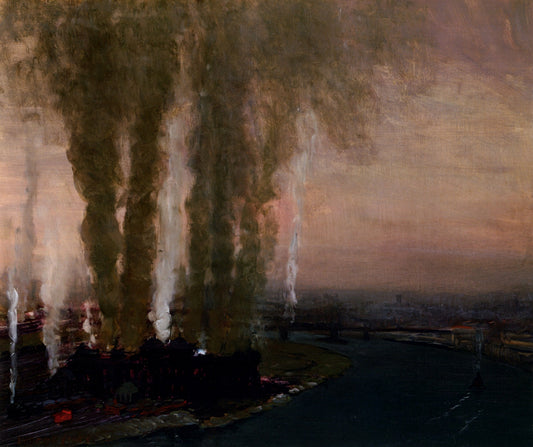
Luks, George (1867-1933) - Roundhouse at High Bridge 1909-10
Vendor:Digital Download - 1 imageRegular price £0.80Regular priceUnit price per -

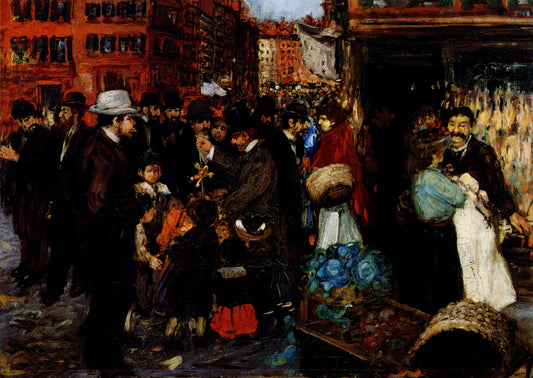
Luks, George (1867-1933) - Hester Street 1905
Vendor:Digital Download - 1 imageRegular price £0.80Regular priceUnit price per


Latest Picture Trove Blog Posts
View all-

William Morris’s Strawberry Thief: The Story Behind a Classic Arts and Crafts Pattern
Few William Morris designs are as instantly recognisable as Strawberry Thief. With its richly patterned foliage, small red strawberries and watchful birds hidden among curling leaves, it has become one of the most loved designs of the Arts and Crafts movement.
-

Glasgow and the Mackintosh Style
We recently took ourselves off to Scotland, and on our travels, we popped into the Mackintosh Tea Rooms in Glasgow for a bit of a nose around and a spot of lunch.
Glasgow and the Mackintosh Style
We recently took ourselves off to Scotland, and on our travels, we popped into the Mackintosh Tea Rooms in Glasgow for a bit of a nose around and a spot of lunch.
-

A Trip to Edinburgh & Glasgow, and Scottish Art
We have just returned from a well-deserved few days' break in Scotland, visiting both Edinburgh and Glasgow, taking in Scottish art and tea rooms!
A Trip to Edinburgh & Glasgow, and Scottish Art
We have just returned from a well-deserved few days' break in Scotland, visiting both Edinburgh and Glasgow, taking in Scottish art and tea rooms!


