

Jacob van Loo (1614-1670) was a painter of the Dutch Golden Age, chiefly active in Amsterdam and, after 1660, in Paris.
Van Loo is known for his conversational groupings, particularly his mythological and biblical scenes generally attributed to the genre of History painting. He was especially celebrated for the quality of his nudes to the extent that, during his lifetime, particularly his female figures were said to have been considered superior and more popular than those of his Amsterdam contemporary and competitor Rembrandt. Unlike Rembrandt, he drew these nudes on blue paper. In 1663, three years after fleeing to Paris, Jacob van Loo was accepted into the Académie royale de peinture et de sculpture.
Though his father also painted, Jacob's success ensured that he would forever be referred to as the founder of the Van Loo family of painters; a dynasty which was influential in French and European painting from the 17th to the beginning of the 19th century.
Van Loo was born in Sluis, a town in the Dutch Republic. Some sources have speculated that his father, Jan van Loo, may have been a notary, but more often his father is described as a painter from whom Jacob van Loo received his early training. Little is known of van Loo's early history due to the destruction of the city archives in Sluis during World War II. His early influences are said to have included Thomas de Keyser and Jacob Adriaensz Backer.
In 1635, van Loo moved to Amsterdam. In 1642, he married Anna Lengele, the sister of the painter Martinus Lengele (1604-1668). The couple had six children, including the painters Jean van Loo and his better-known brother Louis-Abraham van Loo. Their grandsons, Jean-Baptiste van Loo and Charles-André van Loo were among the most famous French painters of the 18th century. They lived on Rozengracht in the Jordaan district of Amsterdam.
In Amsterdam, van Loo found himself at the centre of an active and competitive circle of artists, which included Rembrandt, Frans Hals and Bartholomeus van der Helst. Around 1640, Eglon van der Neer entered his studio as an apprentice and remained his student for a decade. In 1652 van Loo bought himself citizenship (burgerrecht) of the city of Amsterdam. It was speculated that he did so in the hope of being commissioned to help decorate the newly constructed town hall. In 1654, a poem by Jan Vos counted van Loo among the most significant of Dutch painters, alongside Rembrandt and van der Helst.
The greater part of van Loo's oeuvre was done in the Baroque style that had originated in Rome and had been popularised throughout Europe. He is often referred to as a major influence on Johannes Vermeer, evidence of which can be seen by comparing Vermeer's painting of Diana and Her Companions with van Loo's 1648 version of the same subject (not the 1654 version of Diana and her nymphs often used to dispute the claim of direct influence).
In 1660, van Loo fled from Amsterdam after fatally stabbing someone during an altercation at an inn. He was sentenced to death in absentia, which forever prevented his return to the Dutch Republic. Van Loo settled in Paris, where, in 1663, he was admitted to the Académie de peinture et de sculpture. He died in Paris in 1670, three years after the Van Loo family were naturalised as French citizens.
Images to download
-

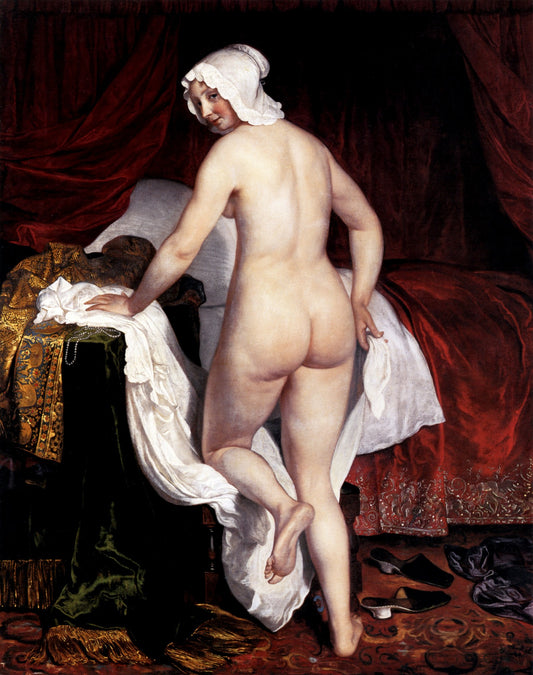
Loo, Jacob van (1614-1670) - Young woman going to bed c.1650
Vendor:Digital Download - 1 imageRegular price £0.80Regular priceUnit price per

Latest Picture Trove Blog Posts
View all-

William Morris’s Strawberry Thief: The Story Behind a Classic Arts and Crafts Pattern
Few William Morris designs are as instantly recognisable as Strawberry Thief. With its richly patterned foliage, small red strawberries and watchful birds hidden among curling leaves, it has become one of the most loved designs of the Arts and Crafts movement.
William Morris’s Strawberry Thief: The Story Behind a Classic Arts and Crafts Pattern
Few William Morris designs are as instantly recognisable as Strawberry Thief. With its richly patterned foliage, small red strawberries and watchful birds hidden among curling leaves, it has become one of the most loved designs of the Arts and Crafts movement.
-

Glasgow and the Mackintosh Style
We recently took ourselves off to Scotland, and on our travels, we popped into the Mackintosh Tea Rooms in Glasgow for a bit of a nose around and a spot of lunch.
Glasgow and the Mackintosh Style
We recently took ourselves off to Scotland, and on our travels, we popped into the Mackintosh Tea Rooms in Glasgow for a bit of a nose around and a spot of lunch.
-

A Trip to Edinburgh & Glasgow, and Scottish Art
We have just returned from a well-deserved few days' break in Scotland, visiting both Edinburgh and Glasgow, taking in Scottish art and tea rooms!
A Trip to Edinburgh & Glasgow, and Scottish Art
We have just returned from a well-deserved few days' break in Scotland, visiting both Edinburgh and Glasgow, taking in Scottish art and tea rooms!


