

George Inness (1825–1894) was an American landscape painter whose career connected the Hudson River School with the more atmospheric painting of the French Barbizon School and American Tonalism. His landscapes are admired for their expressive colour, softened outlines and deeply felt sense of place. Rather than copying every detail of nature, he sought to convey its emotional and spiritual character.
Born in Newburgh, New York, on 1 May 1825, Inness grew up mainly in New Jersey. Poor health disrupted his education, and his artistic training was limited. He studied briefly with John Jesse Barker and later with Régis François Gignoux, while learning composition from engravings after European masters. In 1844 he began exhibiting at the National Academy of Design.
Early works reflected the influence of Thomas Cole and Asher B. Durand, leading painters of the Hudson River School. However, Inness gradually developed a more personal style. Visits to Europe in the 1850s brought him into contact with the work of Claude Lorrain and the French Barbizon painters, especially Théodore Rousseau. Their interest in modest rural scenery, changing light and broad areas of tone had a profound effect on his painting.
Inness spent periods in Massachusetts and New Jersey and lived in Italy between 1870 and 1874. He eventually settled in Montclair, New Jersey, in 1876, although he continued travelling widely. His subjects often included farmland, woodland, villages, winding roads and open countryside, frequently shown in the warm light of evening or beneath unsettled skies.
His philosophical outlook was shaped by the writings of the Swedish theologian Emanuel Swedenborg, whose ideas encouraged him to view the natural world as an expression of spiritual truths. This influence became increasingly apparent in his later work, as exact detail gave way to unified colour, softened forms and evocative atmosphere.
Among his notable paintings are The Lackawanna Valley (1855), which includes a railway passing through a changing American landscape, and the later Home of the Heron (1893). His mature paintings helped establish an important direction in American Tonalism, where mood and harmony took precedence over precise description.
Inness died on 3 August 1894 while visiting Bridge of Allan in Scotland. He is remembered as one of the most individual American landscape painters of the nineteenth century, combining careful observation with a searching interest in light, colour and spiritual meaning.
Images to download
-

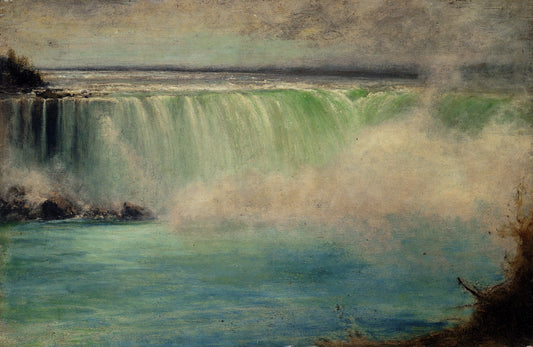
Inness, George (1825-1894) - Niagra Falls 1885
Vendor:Digital Download - 1 imageRegular price £0.80Regular priceUnit price per -

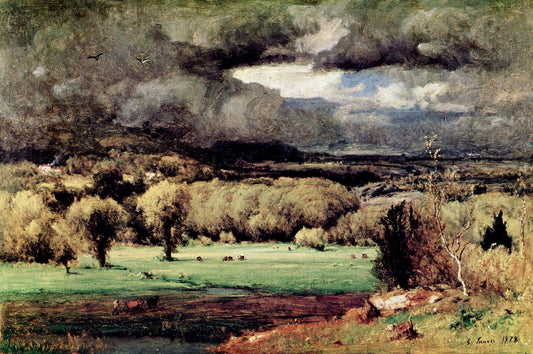
Inness, George (1825-1894) - The Coming Storm 1878
Vendor:Digital Download - 1 imageRegular price £0.80Regular priceUnit price per -

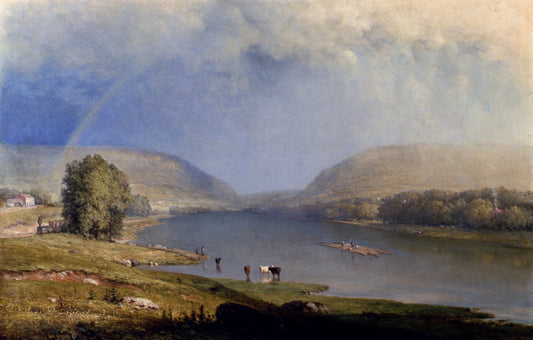
Inness, George (1825-1894) - The Delaware Water Gap c.1857
Vendor:Digital Download - 1 imageRegular price £0.80Regular priceUnit price per -


Inness, George (1825-1894) - The Lackawanna Valley 1855
Vendor:Digital Download - 1 imageRegular price £0.80Regular priceUnit price per -

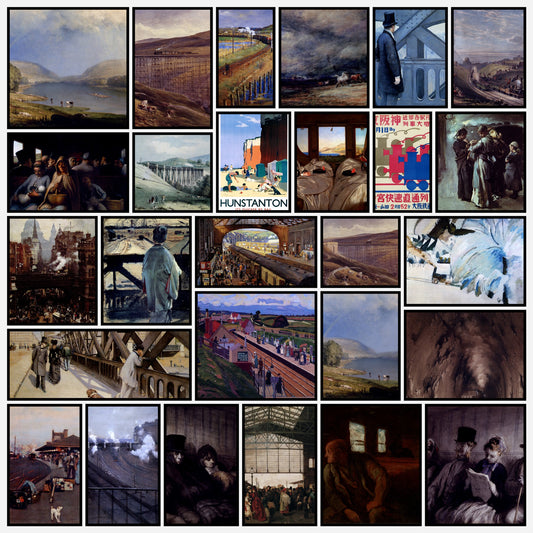
Trains in Art - 105 High Resolution Images
Vendor:Digital Download - 105 imagesRegular price £6.00Regular priceUnit price per


Latest Picture Trove Blog Posts
View all-

Public Domain Artwork and Trade Marks: What You Need to Know
Artwork in the public domain can generally be reproduced, adapted and used commercially without copyright permission. However, copyright and trade mark rights are separate, and using a public-domain image in certain circumstances could still infringe an existing trade mark.
-

William Morris’s Strawberry Thief: The Story Behind a Classic Arts and Crafts Pattern
Few William Morris designs are as instantly recognisable as Strawberry Thief. With its richly patterned foliage, small red strawberries and watchful birds hidden among curling leaves, it has become one of the most loved designs of the Arts and Crafts movement.
-

Glasgow and the Mackintosh Style
We recently took ourselves off to Scotland, and on our travels, we popped into the Mackintosh Tea Rooms in Glasgow for a bit of a nose around and a spot of lunch.
Glasgow and the Mackintosh Style
We recently took ourselves off to Scotland, and on our travels, we popped into the Mackintosh Tea Rooms in Glasgow for a bit of a nose around and a spot of lunch.


