

Grace Carpenter Hudson (1865–1937) was an American painter celebrated for portraits of Pomo Native American people, particularly children. Born in Potter Valley, Mendocino County, California, she showed an early aptitude for drawing and trained at the San Francisco School of Design. She returned to northern California and established herself as a professional artist in Ukiah.
Following a brief first marriage that ended in divorce, she married the physician and ethnographer John Wilz Napier Hudson in 1890. Her portrait of a crying Pomo child, Little Mendocino (1892), attracted widespread attention and became one of her most frequently reproduced works. Over subsequent decades she painted hundreds of Indigenous sitters, often recording titles and details of their circumstances in her studio records.
Hudson's paintings are notable for their attentive observation and individualised expressions. At the same time, their sometimes sentimental presentation should be understood within the history of European-American depictions of Indigenous communities and the expectations of contemporary collectors. The Orphan (c.1898) belongs to this body of work. Her subjects invite comparison with the different, earlier depictions of Indigenous peoples by Canadian artist Paul Kane, although the two painters worked in distinct settings.
Hudson visited Hawaii in 1901 and later travelled to the American South-West, but Mendocino County remained her home. She died in Ukiah in 1937. Her house and studio, known as the Sun House, are preserved by the Grace Hudson Museum, which holds extensive records of her artistic career.
Images to download
-

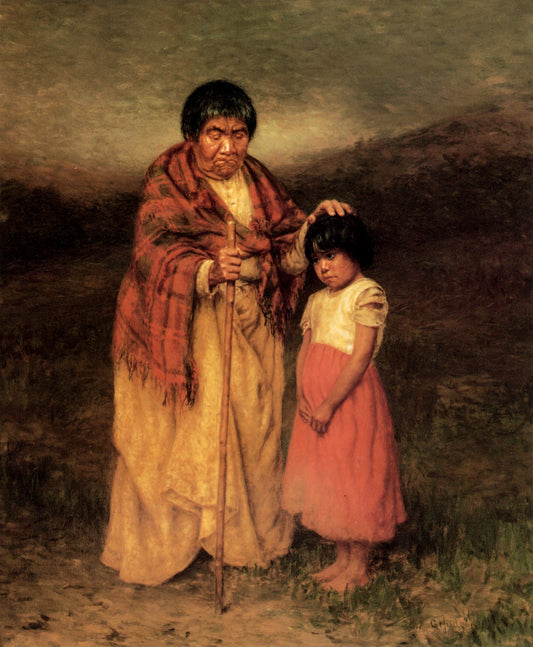
Hudson, Grace Carpenter (1865-1937) - The Orphan c.1898
Vendor:Public Domain Image LibraryRegular price £0.80Regular priceUnit price per

Latest Picture Trove Blog Posts
View all-

Public Domain Artwork and Trade Marks: What You Need to Know
Artwork in the public domain can generally be reproduced, adapted and used commercially without copyright permission. However, copyright and trade mark rights are separate, and using a public-domain image in certain circumstances could still infringe an existing trade mark.
-

William Morris’s Strawberry Thief: The Story Behind a Classic Arts and Crafts Pattern
Few William Morris designs are as instantly recognisable as Strawberry Thief. With its richly patterned foliage, small red strawberries and watchful birds hidden among curling leaves, it has become one of the most loved designs of the Arts and Crafts movement.
-

Glasgow and the Mackintosh Style
We recently took ourselves off to Scotland, and on our travels, we popped into the Mackintosh Tea Rooms in Glasgow for a bit of a nose around and a spot of lunch.
Glasgow and the Mackintosh Style
We recently took ourselves off to Scotland, and on our travels, we popped into the Mackintosh Tea Rooms in Glasgow for a bit of a nose around and a spot of lunch.


