

Hans Holbein the Elder (c.1460–1524) was a German painter and draughtsman who worked principally in Augsburg, one of southern Germany's most important artistic and commercial centres. Born around 1460–65, he emerged from the late Gothic tradition but gradually absorbed influences from Netherlandish and Italian Renaissance painting.
His workshop produced altarpieces, devotional panels, portraits and drawings for churches and wealthy patrons. Religious subjects allowed Holbein to combine elaborate drapery, richly coloured costumes and carefully observed faces with increasingly convincing architectural spaces. Works devoted to the Virgin Mary, including Madonna on the Balcony, belong to a tradition in which sacred figures were presented with emotional immediacy and attention to everyday detail.
Holbein's drawings reveal his particular strength as an observer of human character. He also produced portraits and studies of individuals outside strictly religious settings. His workshop was large and active, and included the painters Leonhard Beck and, at different times, his sons. Both Ambrosius and Hans Holbein the Younger developed as artists within the northern Renaissance world shaped by their father. The younger Hans went on to become a major portrait painter at the English court of Henry VIII.
Financial and professional difficulties affected Holbein's later career, and he worked away from Augsburg towards the end of his life. Although sources differ about his final residence and exact circumstances, 1524 is a commonly accepted year of death. His paintings occupy an important position between the ornate art of the late Middle Ages and the emerging Renaissance interest in individual likeness and naturalistic space.
Images to download
-

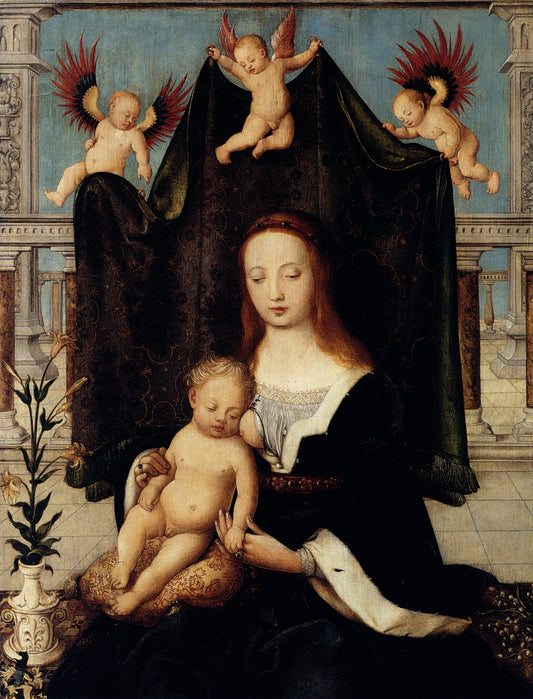
Holbein the Elder, Hans (1460-1524) - Madonna on the Balcony
Vendor:Public Domain Image LibraryRegular price £0.80Regular priceUnit price per

Latest Picture Trove Blog Posts
View all-

Public Domain Artwork and Trade Marks: What You Need to Know
Artwork in the public domain can generally be reproduced, adapted and used commercially without copyright permission. However, copyright and trade mark rights are separate, and using a public-domain image in certain circumstances could still infringe an existing trade mark.
-

William Morris’s Strawberry Thief: The Story Behind a Classic Arts and Crafts Pattern
Few William Morris designs are as instantly recognisable as Strawberry Thief. With its richly patterned foliage, small red strawberries and watchful birds hidden among curling leaves, it has become one of the most loved designs of the Arts and Crafts movement.
-

Glasgow and the Mackintosh Style
We recently took ourselves off to Scotland, and on our travels, we popped into the Mackintosh Tea Rooms in Glasgow for a bit of a nose around and a spot of lunch.
Glasgow and the Mackintosh Style
We recently took ourselves off to Scotland, and on our travels, we popped into the Mackintosh Tea Rooms in Glasgow for a bit of a nose around and a spot of lunch.


