

William Hind (1833–1889) William George Richardson Hind was a British-born Canadian painter and illustrator noted for vivid watercolours recording travel, landscapes and life in nineteenth-century Canada. He was born in Nottingham on 12 June 1833 and emigrated to Canada in 1851, joining his elder brother Henry Youle Hind in Toronto. Henry became a prominent geologist and explorer, while William developed his career as an artist.
Hind accompanied his brother's explorations of the interior of the Labrador Peninsula in 1861, producing drawings and watercolours of the landscape and people encountered. His studies are important early visual records of the region, although they must be read with awareness of the outlook of a European settler travelling through Indigenous territories.
During the 1860s he travelled west and recorded scenes of the Canadian prairies and the journeys of emigrants, including the Red River carts associated with overland transport. His sketches were valued for their immediacy and detail, and some were reproduced as illustrations. The surviving Overlanders sketchbook is an especially interesting record of travel towards the Rocky Mountains.
Hind's landscapes and depictions of Indigenous communities can be compared with those of Paul Kane, who had travelled in western Canada earlier. Both artists made pictures that are historically important as well as visually engaging, although their observations were shaped by their cultural positions.
Hind also undertook sign painting and other practical artistic work to support himself. A Self-portrait from around 1863 shows the artist at work and provides a personal record quite different from his outdoor studies. He died unmarried in Sussex, New Brunswick, on 18 November 1889. His death year is sometimes incorrectly given as 1899.
Images to download
-

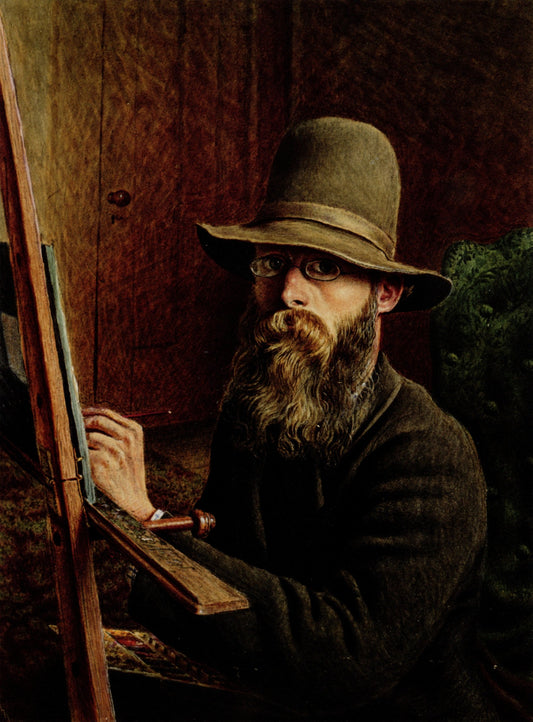
Hind, William (1833-1889) - Self-portrait c.1863
Vendor:Public Domain Image LibraryRegular price £0.80Regular priceUnit price per

Latest Picture Trove Blog Posts
View all-

Public Domain Artwork and Trade Marks: What You Need to Know
Artwork in the public domain can generally be reproduced, adapted and used commercially without copyright permission. However, copyright and trade mark rights are separate, and using a public-domain image in certain circumstances could still infringe an existing trade mark.
-

William Morris’s Strawberry Thief: The Story Behind a Classic Arts and Crafts Pattern
Few William Morris designs are as instantly recognisable as Strawberry Thief. With its richly patterned foliage, small red strawberries and watchful birds hidden among curling leaves, it has become one of the most loved designs of the Arts and Crafts movement.
-

Glasgow and the Mackintosh Style
We recently took ourselves off to Scotland, and on our travels, we popped into the Mackintosh Tea Rooms in Glasgow for a bit of a nose around and a spot of lunch.
Glasgow and the Mackintosh Style
We recently took ourselves off to Scotland, and on our travels, we popped into the Mackintosh Tea Rooms in Glasgow for a bit of a nose around and a spot of lunch.


