

Thomas Hickey (1741–1824) was an Irish portrait painter and traveller whose career took him across Europe and Asia. Born in Dublin in May 1741, he trained at the Dublin Society's schools and established a reputation for fluent portraiture. Like many ambitious artists of the eighteenth century, he travelled in search of patrons, working in Britain and Portugal before making his career further afield.
Among his British sitters was the actress Frances Abington, whom he portrayed in 1775 as Lady Bab Lardoon in John Burgoyne's play The Maid of the Oaks. The painting reflects the popularity of fashionable theatrical portraits and the close relationship between visual art, celebrity and London social life. The portrait tradition in which Hickey worked can be compared with the pictures of William Hoare, who likewise depended on commissions from prominent sitters.
Hickey first travelled to India in the 1780s, establishing a portrait practice among British officials and other members of colonial society. He also portrayed Indian subjects, leaving a varied record of the people he encountered. After returning to Europe, he joined Lord Macartney's embassy to China in 1792–94 as its official portraitist.
His career was marked by repeated journeys, changing commissions and periods of financial uncertainty. Hickey returned to India in 1798 and eventually settled in Madras, now Chennai. His works provide evidence of the international networks through which artists, patrons and colonial institutions operated during the period. He died in Madras in 1824.
Although he never attained the reputation of the most celebrated British portraitists, his unusually extensive travels and diverse sitters make him an interesting figure in the history of Irish and colonial-era art.
Images to download
-

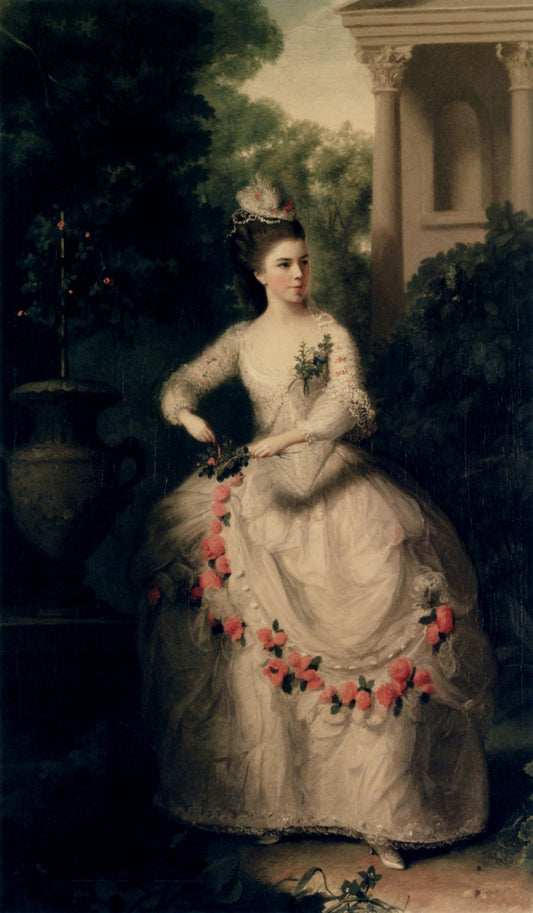
Hickey, Thomas (1741-1824) - Francis Abington As Lady Bab Lardoon in the Maid of Oaks 1775
Vendor:Public Domain Image LibraryRegular price £0.80Regular priceUnit price per

Latest Picture Trove Blog Posts
View all-

Public Domain Artwork and Trade Marks: What You Need to Know
Artwork in the public domain can generally be reproduced, adapted and used commercially without copyright permission. However, copyright and trade mark rights are separate, and using a public-domain image in certain circumstances could still infringe an existing trade mark.
-

William Morris’s Strawberry Thief: The Story Behind a Classic Arts and Crafts Pattern
Few William Morris designs are as instantly recognisable as Strawberry Thief. With its richly patterned foliage, small red strawberries and watchful birds hidden among curling leaves, it has become one of the most loved designs of the Arts and Crafts movement.
-

Glasgow and the Mackintosh Style
We recently took ourselves off to Scotland, and on our travels, we popped into the Mackintosh Tea Rooms in Glasgow for a bit of a nose around and a spot of lunch.
Glasgow and the Mackintosh Style
We recently took ourselves off to Scotland, and on our travels, we popped into the Mackintosh Tea Rooms in Glasgow for a bit of a nose around and a spot of lunch.


