

John Haberle (1856–1933) was an American painter celebrated for ingenious trompe-l'œil still lifes, designed to make painted objects appear real. Born in New Haven, Connecticut, he trained at the National Academy of Design and worked as an illustrator and engraver before concentrating on painting.
Haberle became particularly skilled at depicting paper currency, photographs, stamps, tickets, newspaper cuttings and other everyday printed materials. The accuracy of his brushwork invited viewers to mistake the painted objects for actual pieces of paper attached to a surface. This fascination with illusion connected his work with a wider American tradition of realist still-life painting.
Reproduction (1888) features a worn ten-dollar Treasury note and fragments of printed paper apparently lying against a dark background. The carefully rendered creases, edges and shadows create a visual trick while referring to the growing importance of printed imagery and the circulation of money in modern society.
Haberle worked within the American tradition of illusionistic still life, alongside William Michael Harnett and John F. Peto. They pursued related effects of deception, although this does not establish that they worked together. Haberle's pictures attracted attention partly because the depiction of currency could raise questions about counterfeiting. His distinctive art combined humour, technical virtuosity and a fascination with the ordinary objects of American life. He died in New Haven in 1933.
Images to download
-

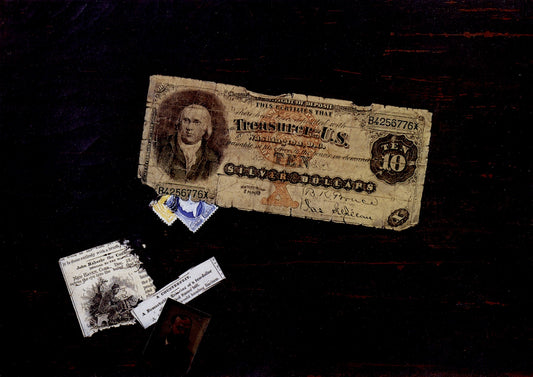
Haberle, John (1856-1933) - Reproduction 1888
Vendor:Public Domain Image LibraryRegular price £0.80Regular priceUnit price per

Latest Picture Trove Blog Posts
View all-

Public Domain Artwork and Trade Marks: What You Need to Know
Artwork in the public domain can generally be reproduced, adapted and used commercially without copyright permission. However, copyright and trade mark rights are separate, and using a public-domain image in certain circumstances could still infringe an existing trade mark.
-

William Morris’s Strawberry Thief: The Story Behind a Classic Arts and Crafts Pattern
Few William Morris designs are as instantly recognisable as Strawberry Thief. With its richly patterned foliage, small red strawberries and watchful birds hidden among curling leaves, it has become one of the most loved designs of the Arts and Crafts movement.
-

Glasgow and the Mackintosh Style
We recently took ourselves off to Scotland, and on our travels, we popped into the Mackintosh Tea Rooms in Glasgow for a bit of a nose around and a spot of lunch.
Glasgow and the Mackintosh Style
We recently took ourselves off to Scotland, and on our travels, we popped into the Mackintosh Tea Rooms in Glasgow for a bit of a nose around and a spot of lunch.


