

Lady Elizabeth Butler (1846–1933), born Elizabeth Southerden Thompson, was a British painter best known for her dramatic scenes of military life. At a time when few women achieved public recognition as painters of historical subjects, she became one of the most popular artists exhibiting at the Royal Academy.
Butler was born near Lausanne, Switzerland, on 3 November 1846, to British parents. She grew up in a well-travelled family and received encouragement in drawing from an early age. She studied at the Female School of Art in South Kensington and continued her artistic training in Italy. Her interest in history and military subjects developed after she observed army manoeuvres in England.
Her breakthrough came in 1874 with The Roll Call, a painting of exhausted and wounded soldiers assembling after a battle during the Crimean War. Exhibited at the Royal Academy, it attracted enormous crowds and was acquired by Queen Victoria. Rather than concentrating solely on military leaders or victories, Butler portrayed the experiences and hardships of ordinary soldiers.
She followed this success with other major works, including The 28th Regiment at Quatre Bras (1875), The Remnants of an Army (1879) and Scotland Forever! (1881), her famous depiction of a cavalry charge at Waterloo. Her careful attention to uniforms, horses and military formations contributed to the force of these paintings.
In 1877 she married the Irish soldier William Francis Butler, later a general, and travelled with him to several parts of the British Empire. These journeys supplied material for her paintings, sketches and published travel accounts. In 1879 she narrowly missed election as an associate of the Royal Academy.
Butler’s dramatic historical scenes can be compared with the military and historical illustrations of Sir John Gilbert, although her emphasis on the physical and emotional toll of warfare gave her paintings a distinctive character.
After her husband’s death in 1910 she lived mainly in Ireland. She died at Gormanston Castle, County Meath, on 2 October 1933. Her paintings remain notable for their detailed observation of soldiers and their experiences of war.
Images to download
-

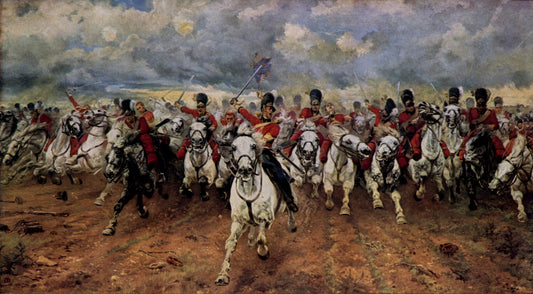
Butler, Lady Elizabeth (1846-1933) - Scotland for Ever! 1881
Vendor:Digital Download - 1 imageRegular price £0.80Regular priceUnit price per -


Women Artists - 180 High Resolution Images
Vendor:Digital Download - 180 imagesRegular price £10.00Regular priceUnit price per


Latest Picture Trove Blog Posts
View all-

Public Domain Artwork and Trade Marks: What You Need to Know
Artwork in the public domain can generally be reproduced, adapted and used commercially without copyright permission. However, copyright and trade mark rights are separate, and using a public-domain image in certain circumstances could still infringe an existing trade mark.
-

William Morris’s Strawberry Thief: The Story Behind a Classic Arts and Crafts Pattern
Few William Morris designs are as instantly recognisable as Strawberry Thief. With its richly patterned foliage, small red strawberries and watchful birds hidden among curling leaves, it has become one of the most loved designs of the Arts and Crafts movement.
-

Glasgow and the Mackintosh Style
We recently took ourselves off to Scotland, and on our travels, we popped into the Mackintosh Tea Rooms in Glasgow for a bit of a nose around and a spot of lunch.
Glasgow and the Mackintosh Style
We recently took ourselves off to Scotland, and on our travels, we popped into the Mackintosh Tea Rooms in Glasgow for a bit of a nose around and a spot of lunch.


