

Frank Bramley RA (1857-1915) was an English post-impressionist genre painter of the Newlyn School.
Bramley was born on 6 May 1857 in Sibsey, near Boston, in Lincolnshire, to Charles Bramley from Fiskerton, also in Lincolnshire.
From 1873 to 1878 Bramley studied at the Lincoln School of Art. He then studied from 1879 to 1882 at the Royal Academy of Fine Arts in Antwerp, where Charles Verlat was his instructor. He lived in Venice from 1882 to 1884 and then moved to Newlyn, Cornwall.
Having returned to England from Venice in or after 1884, Bramley established himself in the Newlyn School artist colony on Rue des Beaux Arts in Newlyn. Along with Walter Langley and Stanhope Forbes, he was considered to be one of the "leading figures" of the Newlyn School.
In contrast to other members of the Newlyn School, Bramley specialised in interiors and worked on combining natural and artificial light in his paintings, such as A Hopeless Dawn.
During his time in Newlyn, Bramley was a particular exponent of the ‘square brush technique’, using the flat of a square brush to lay the paint on the canvas in a jigsaw pattern of brush strokes, giving a particular vibrancy to the paint surface. In the early 1890s, his palette became brighter and his handling of the paint looser and more impastoed, while his subject matter narrowed to portraits and rural genre paintings.
Bramley married fellow artist Katherine Graham, daughter of John Graham from Huntingstile, Grasmere, Westmorland, in 1891. The couple lived at Orchard Cottage, which at the time was called Belle Vue Cottage, from 1893 to 1897. In 1895 they moved to Droitwich in the West Midlands. They lived at Bellue Vue House in 1889 and by 1900 had settled at Grasmere in the Lake District.
In 1894 Bramley became an Associate of the Royal Academy (ARA), and in 1911 he became a Royal Academician (RA). He was also a gold medal winner at the Paris Salon.
Bramley died in Chalford Hill, Gloucestershire, on 9th August 1915.
Images to download
-

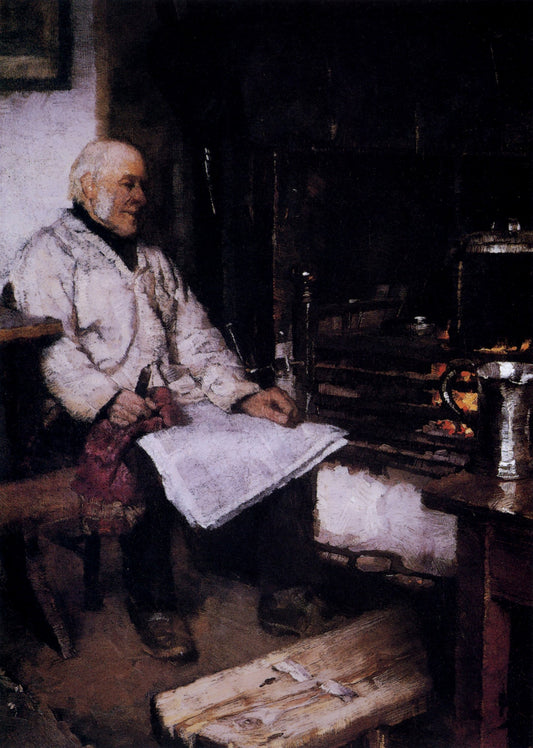
Bramley, Frank (1857-1915) - Winter 1885
Vendor:Digital Download - 1 imageRegular price £0.80Regular priceUnit price per -

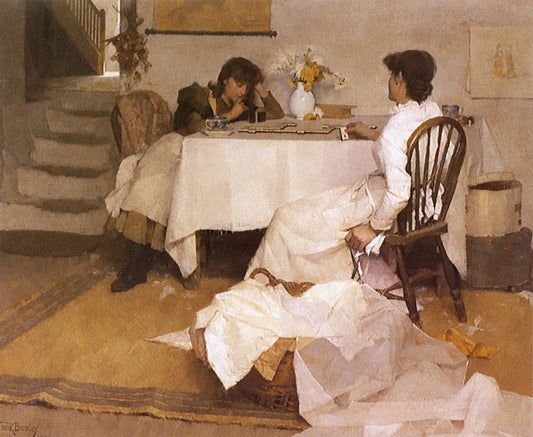
Bramley, Frank (1857-1915) - Domino 1886
Vendor:Digital Download - 1 imageRegular price £0.80Regular priceUnit price per


Latest Picture Trove Blog Posts
View all-

William Morris’s Strawberry Thief: The Story Behind a Classic Arts and Crafts Pattern
Few William Morris designs are as instantly recognisable as Strawberry Thief. With its richly patterned foliage, small red strawberries and watchful birds hidden among curling leaves, it has become one of the most loved designs of the Arts and Crafts movement.
William Morris’s Strawberry Thief: The Story Behind a Classic Arts and Crafts Pattern
Few William Morris designs are as instantly recognisable as Strawberry Thief. With its richly patterned foliage, small red strawberries and watchful birds hidden among curling leaves, it has become one of the most loved designs of the Arts and Crafts movement.
-

Glasgow and the Mackintosh Style
We recently took ourselves off to Scotland, and on our travels, we popped into the Mackintosh Tea Rooms in Glasgow for a bit of a nose around and a spot of lunch.
Glasgow and the Mackintosh Style
We recently took ourselves off to Scotland, and on our travels, we popped into the Mackintosh Tea Rooms in Glasgow for a bit of a nose around and a spot of lunch.
-

A Trip to Edinburgh & Glasgow, and Scottish Art
We have just returned from a well-deserved few days' break in Scotland, visiting both Edinburgh and Glasgow, taking in Scottish art and tea rooms!
A Trip to Edinburgh & Glasgow, and Scottish Art
We have just returned from a well-deserved few days' break in Scotland, visiting both Edinburgh and Glasgow, taking in Scottish art and tea rooms!


