

The Barbizon School was a group of French landscape painters active in the mid-nineteenth century, whose innovative approach to art laid the groundwork for modern landscape painting and influenced later movements such as Impressionism. Named after the village of Barbizon, near the Forest of Fontainebleau, the school rejected the classical conventions of academic painting and instead embraced direct observation of nature, striving to capture its changing moods and atmospheric effects.
Emerging in the 1830s and flourishing through the 1870s, the Barbizon School’s artists sought to move away from the idealised and often theatrical scenes promoted by the Paris Salon. Instead, they ventured outdoors with their easels, painting 'en plein air' and focusing on the humble, everyday beauty of rural life and natural landscapes. Their work is characterised by a commitment to realism, an earthy palette, and a keen sensitivity to light and weather.
Key features of the Barbizon School include a preference for scenes depicting forests, streams, fields, and peasant labourers. The artists often painted the same locations repeatedly, seeking to evoke the tranquillity and authenticity of the French countryside. Their brushwork ranged from delicate and precise to loose and expressive, reflecting their individual responses to the landscape.
Prominent artists associated with the Barbizon School include:
Jean-Baptiste-Camille Corot (1796-1875)
Théodore Rousseau (1812-1867)
Jean-François Millet (1814-1875)
Charles-François Daubigny (1817-1878)
Jules Dupré (1811-1889)
Narcisse Virgilio Díaz de la Peña (1807-1876)
Constant Troyon (1810-1865)
Charles Jacque (1813-1894)
Henri Harpignies (1819-1916)
Among them, Jean-François Millet is particularly noted for his empathetic portrayals of rural workers, such as “The Gleaners” and “The Angelus,” while Corot bridged the gap between classical landscape and Impressionism with his poetic vision and mastery of light. Rousseau, regarded as a leader of the group, was especially devoted to the Forest of Fontainebleau, capturing its grandeur and variety.
The Barbizon School’s influence extended beyond France, inspiring artists in Britain and throughout Europe to explore nature with renewed directness and sincerity. Their dedication to painting from life and their focus on ordinary subjects helped pave the way for Impressionism and the development of modern art. Today, their works are celebrated for their beauty, realism, and enduring connection to the natural world.
Images to download
-


Millet, Jean-François (1814-1875) - The Sheepfold, Moonlight 1856-60
Vendor:Digital Download - 1 imageRegular price £0.80Regular priceUnit price per -


Millet, Jean-François (1814-1875) - The Gleaners 1857
Vendor:Digital Download - 1 imageRegular price £0.80Regular priceUnit price per -


Díaz, Narcisse Virgilio (1807-1876) - Pond in the Woods 1862
Vendor:Digital Download - 1 imageRegular price £0.80Regular priceUnit price per -

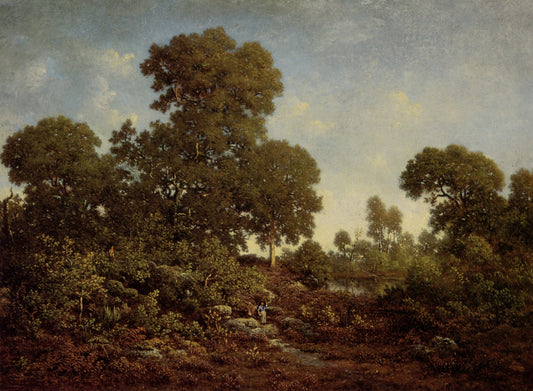
Rousseau, Theodore (1812-1867) - Springtime c.1860
Vendor:Digital Download - 1 imageRegular price £0.80Regular priceUnit price per -


Millet, Jean-François (1814-1875) - The Boiler 1853-54
Vendor:Digital Download - 1 imageRegular price £0.80Regular priceUnit price per -


Millet, Jean-François (1814-1875) - Young Peasant Girl in a Pasture 1843-44
Vendor:Digital Download - 1 imageRegular price £0.80Regular priceUnit price per -


Millet, Jean-François (1814-1875) - Woman Churning Butter 1866-68
Vendor:Digital Download - 2 imagesRegular price £0.80Regular priceUnit price per -


Millet, Jean-François (1814-1875) - The Angelus
Vendor:Digital Download - 1 imageRegular price £0.80Regular priceUnit price per -


Millet, Jean-François (1814-1875) - Shepherd Tending his Flock 1860s
Vendor:Digital Download - 1 imageRegular price £0.80Regular priceUnit price per -


Corot, Jean-Baptiste C. (1796-1875) - Agostina 1866
Vendor:Digital Download - 1 imageRegular price £0.80Regular priceUnit price per -


Corot, Jean-Baptiste C. (1796-1875) - Moulin de la Galette, Montmartre 1840
Vendor:Digital Download - 1 imageRegular price £0.80Regular priceUnit price per -


Troyon, Constant (1810-1865) - Hound Pointing 1860
Vendor:Digital Download - 1 imageRegular price £0.80Regular priceUnit price per -


Troyon, Constant (1810-1865) - Coast near Villers c.1859
Vendor:Digital Download - 1 imageRegular price £0.80Regular priceUnit price per -


Corot, Jean-Baptiste C. (1796-1875) - Christine Nilsson
Vendor:Digital Download - 1 imageRegular price £0.80Regular priceUnit price per -


Millet, Jean-François (1814-1875) - The Potato Harvest 1855
Vendor:Digital Download - 1 imageRegular price £0.80Regular priceUnit price per -


Millet, Jean-François (1814-1875) - The Goose Girl c.1863
Vendor:Digital Download - 1 imageRegular price £0.80Regular priceUnit price per


Latest Picture Trove Blog Posts
View all-

William Morris’s Strawberry Thief: The Story Behind a Classic Arts and Crafts Pattern
Few William Morris designs are as instantly recognisable as Strawberry Thief. With its richly patterned foliage, small red strawberries and watchful birds hidden among curling leaves, it has become one of the most loved designs of the Arts and Crafts movement.
-

Glasgow and the Mackintosh Style
We recently took ourselves off to Scotland, and on our travels, we popped into the Mackintosh Tea Rooms in Glasgow for a bit of a nose around and a spot of lunch.
Glasgow and the Mackintosh Style
We recently took ourselves off to Scotland, and on our travels, we popped into the Mackintosh Tea Rooms in Glasgow for a bit of a nose around and a spot of lunch.
-

A Trip to Edinburgh & Glasgow, and Scottish Art
We have just returned from a well-deserved few days' break in Scotland, visiting both Edinburgh and Glasgow, taking in Scottish art and tea rooms!
A Trip to Edinburgh & Glasgow, and Scottish Art
We have just returned from a well-deserved few days' break in Scotland, visiting both Edinburgh and Glasgow, taking in Scottish art and tea rooms!


